
Relatórios de Atividade IPAM – 2025
IPAM, uma instituição com 30 anos de existência, sempre se renovando, olhando para um futuro sustentável e justo para o Brasil. Cuidando também do clima global, da proteção das florestas, ajudando a desenvolver uma agricultura sustentável e construindo ferramentas...


The intrinsic effects of environment and space on the composition of woody plant species vary between Brazilian savannas growing on distinct types of substrate
The relationship between the floristic composition of communities and the underlying environmental and spatial determinants is still the subject of intense debate, mainly because only recently has geographical distance been cited as an important driver of plant...
Relatório – Seminário Nacional do Cerrado
Em 2017, o IPAM promoveu um encontro em Brasília para discutir como conciliar produção agropecuária e conservação da sociobiodiversidade no Cerrado. O Cerrado é um bioma de fundamental importância ambiental, econômica e social para o Brasil.O bioma abriga uma...
EXTRACTIVE RESERVES IN THE BRAZILIAN AMAZON THIRTY YEARS AFTER CHICO MENDES: SOCIAL MOVEMENT ACHIEVEMENTS, TERRITORIAL EXPANSION AND CONTINUING STRUGGLES
The Brazilian Amazon contains the largest remaining contiguous forest in the tropics, but also faces strong development pressures and one of the highest rates of deforestation in the world. In the 30 years since the murder of the rubber tapper leader Chico Mendes...
Deep soils modify environmental consequences of increased nitrogen fertilizer use in intensifying Amazon agriculture
Intensively-managed croplands and nitrogen (N) fertilizer use are expanding rapidly in tropical regions. We quantified fertilizer responses of maize yield, N2O emissions, and N leaching in an Amazon soybeanmaize double-cropping system on deep, highly-weathered soils in Mato Grosso, Brazil.
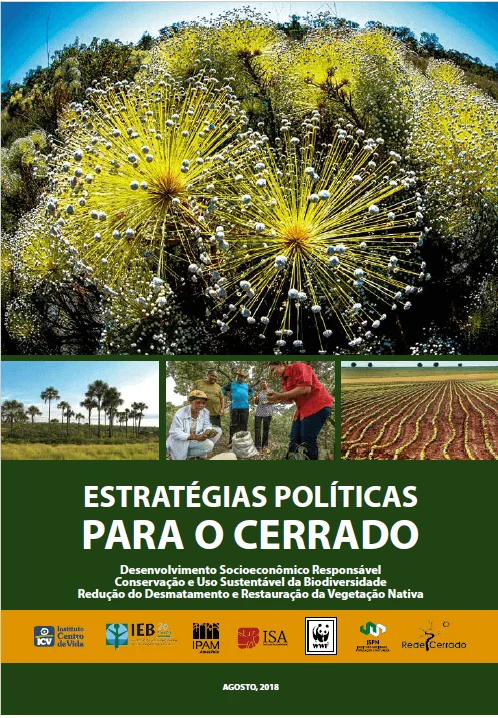
Estratégias políticas para o Cerrado
Documento reúne 27 recomendações em defesa do Cerrado, seus povos e comunidades tradicionais. Organização: Instituto Centro de Vida (ICV), Instituto Internacional de Educação do Brasil (IEB), Instituto de Pesquisa Ambiental da Amazônia (Ipam), Instituto Sociedade, População e Natureza (ISPN), Instituto Socioambiental (ISA), Rede Cerrado e WWF-Brasil.
ENSO Drives interannual variation of forest woody growth across the tropics
Meteorological extreme events such as El Niño events are expected to affect tropical forest net primary production (NPP) and woody growth, but there has been no large-scale empirical validation of this expectation. We collected a large high–temporal resolution...