
Suellen Nunes*
In the diverse landscape of Amazonian agroforestry, there is no single producer profile or path. Between different ages, histories and ways of producing, SAFs (Agroforestry Systems) have been built from trajectories that, although different, share the same objective: to produce sustainably and guarantee permanence in the countryside.
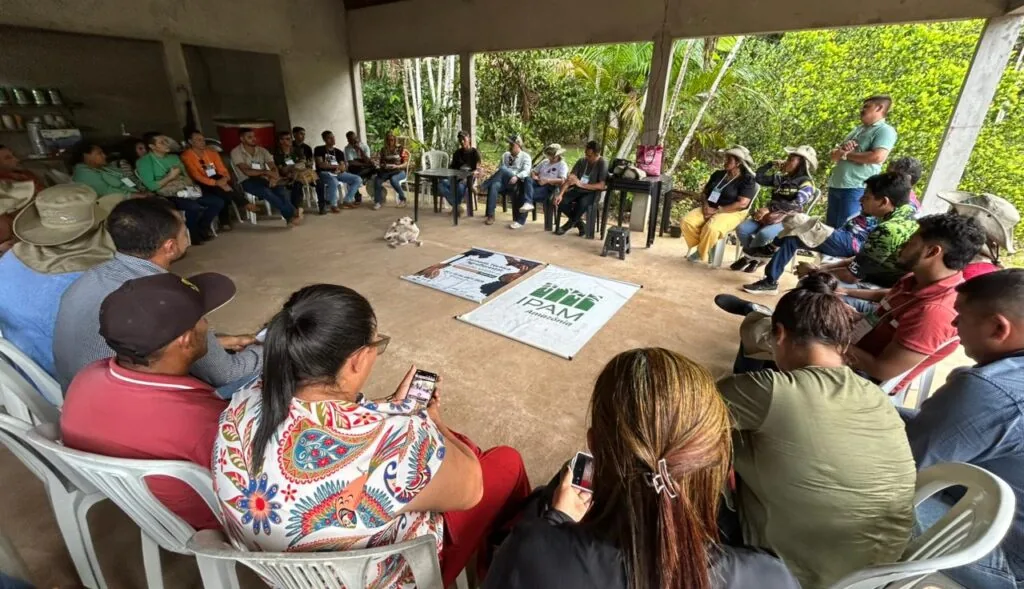
During the “Agroforestry Technical Day”, held in Tomé-Açu by IPAM (Amazon Environmental Research Institute), in partnership with GIZ (German-Brazilian Cooperation for Sustainable Development), four properties supported by IPAM projects showed this diversity in practice. The systems visited reveal different stages of development, levels of organization and production strategies, ranging from family initiatives in consolidation to larger-scale structured models.
The strength of women in the countryside
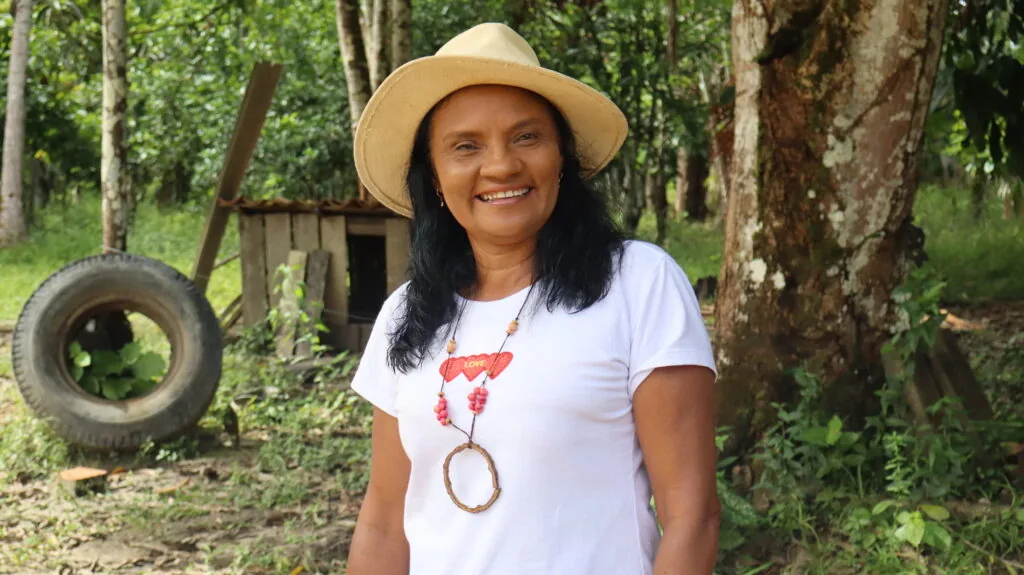
Ginelda Lima, the owner of one of the areas we visited in Tomé-Açu, stands out as an enterprising woman who runs her production independently. A family farmer, she has structured a system based on manioc, combined with açaí, cumaru and cocoa, together with the operation of a flour mill and adding value to the product.
The producer’s experience is part of the Forest Restoration Project with Agroforestry Systems and Natural Regeneration, developed in partnership with Conservation International Brazil, with support from Daikin. The initiative is also part of the project “Forest Restoration in the Amazon: recovery of altered areas in the state of Pará, within the scope of the Regularize Rural Project”, supported by the Brazilian Forestry Service, which seeks to strengthen sustainable production practices and the recovery of degraded areas in the state.
“Flour was just a monoculture in my life and I had tons of it sitting idle, with no market. But I decided to invest in the quality, packaging and value of my product. Today, it reaches other states and even other countries. This only happened because someone believed in me and because I didn’t give up either. My production involves other families, generates income and opens up opportunities for more people,” she explains.
Access to knowledge and the new generation
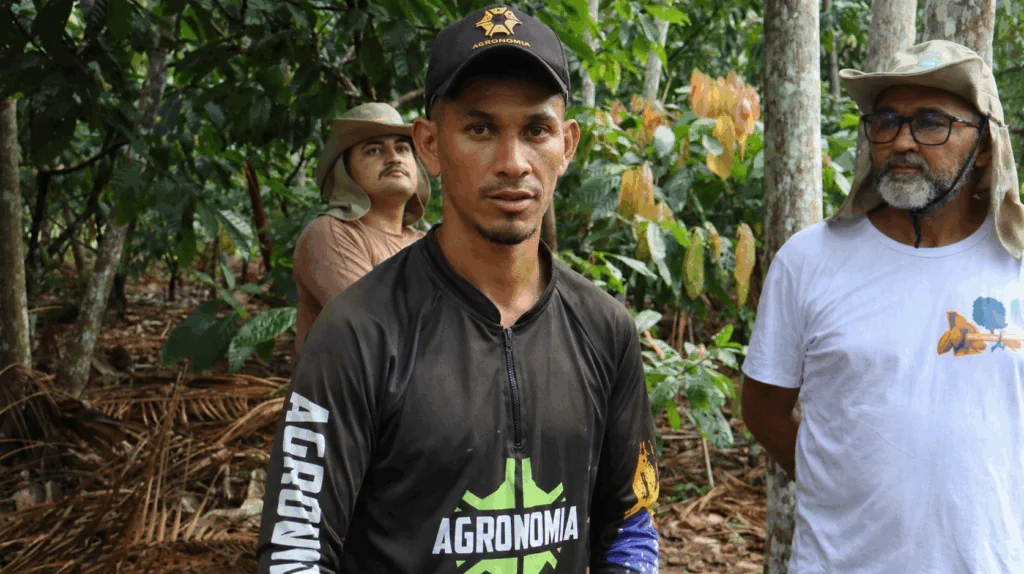
In another context, Adeilton Mendes, 32, represents a new generation that has remained in the countryside through family succession. A young farmer and agronomy student, he has continued the work started by his father, incorporating technical knowledge, planning and productive diversification.
His career is also linked to the Forest Restoration Project with Agroforestry Systems and Natural Regeneration in Tomé-Açu, developed in partnership with Conservation International Brazil and with support from Daikin, which encourages the adoption of more sustainable and resilient production systems in the region.
“I started working on the property at a young age, after my father gave me a piece of land. At first it was difficult, there was a lack of technical information and organization, and I ended up working a lot while earning little. That’s when I decided to invest in knowledge, study and apply it in practice. Today, I’m able to diversify production and expand activities on the property,” he says.
“When you only work with one crop, you end up being limited. In the agroforestry system, it’s possible to have production throughout the year, with different crops guaranteeing income in various periods. This brings more stability and improves quality of life,” he adds.
The value of experience

The experience accumulated over time can be seen in the career of José Paixão, 72, known as Zé Paixão. A family farmer since his youth, he has built up a diverse agroforestry system over decades, with different crops integrated into the same area.
His story is connected to the Monitoring and Consolidation of Forest Restoration with Agroforestry Systems (SAFs) Project in Tomé-Açu, an initiative supported by Otsuka that monitors the evolution of productive restoration areas in the region.
“I started in a difficult area, where there was almost nothing. I worked little by little, planting different crops. Today, I see my property formed, with diversified production, the result of many years of effort,” he says. “I’ve never been anyone’s employee, I’ve always lived off my own work. I raised my family this way, working the land and believing in what I was doing,” he says.
Sustainability on a large scale
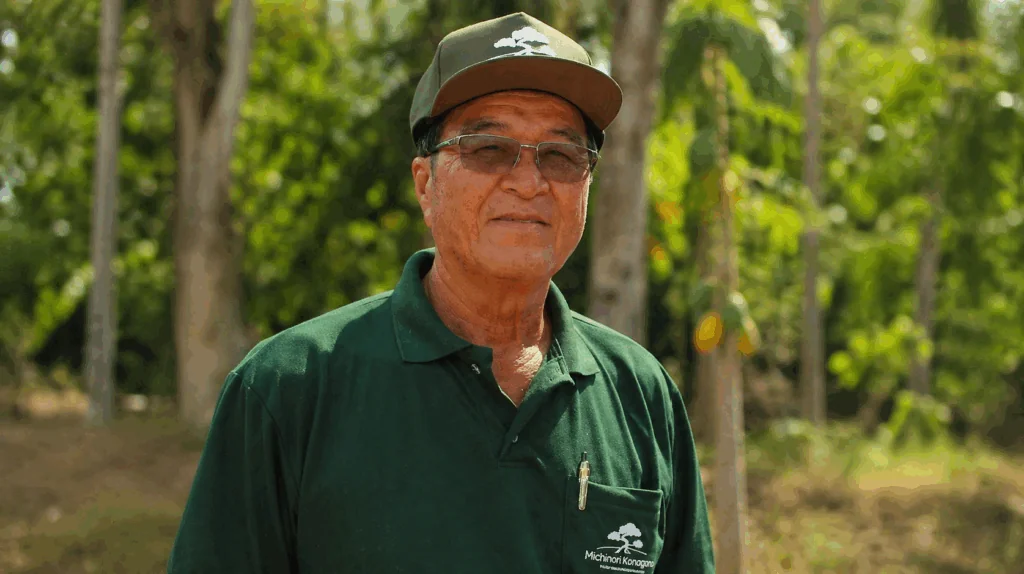
@Michinori_konagano/divulgation
Michinori Konagano, 68, represents a system that has been consolidated on a large scale. Of Japanese origin, he is recognized as a reference in agroforestry production in Tomé-Açu, and is often cited as a model for other producers in the region.
“I arrived in the Amazon at a young age with my family, looking for an opportunity to start over. We encountered many challenges at first, but it was through hard work and persistence that we managed to build our trajectory in the region. Over the years, we have learned to manage the land in a diversified way, integrating crops and respecting nature’s time. Today, the agroforestry system shows that it is possible to produce with balance, guaranteeing income and keeping the forest standing,” he explains.
The producer points out that the development of production in the municipality of Tomé-Açu is the result of dedication and the exchange of knowledge over generations. “Agroforestry requires care and a long-term vision, but it brings security to those who produce. That’s why I’m keen to share this experience, so that more producers can strengthen their systems and grow sustainably,” he concludes.
Despite the differences between the profiles, whether in scale, level of organization or access to technology, the systems share principles such as diversification, integrated management and income generation associated with environmental conservation. At the same time, they highlight the role of institutional partnerships in supporting producers.
From the system run by an enterprising woman, to a young man in family succession and a producer with decades of experience, to a large-scale consolidated model, the SAFs demonstrate that there is no single productive format, but rather multiple possible paths within agroforestry.
The program of visits to Tomé-Açu is part of the “Projeto Regulariza Rural” project, coordinated by the SFB (Brazilian Forestry Service) and IICA Brazil (Inter-American Institute for Cooperation on Agriculture), with financial support from KfW (German Development Bank). The initiative supports the states of Pará, Mato Grosso and Rondônia in implementing environmental regularization and monitoring native vegetation. In Pará, the actions are promoted by IPAM, in partnership with Semas.
IPAM communications analyst*.