Mayara Subtil and Suellen Nunes*
Native to the Amazon region, cocoa is one of the state’s main production chains and is the basis of a bioeconomy that generates income for family farming, traditional and riverside communities, preserves the standing forest and contributes to the recovery of degraded areas. In this context, initiatives that strengthen the production chain and increase the sector’s visibility are even more important.
It was with this in mind that, between April 23 and 26, the Hangar Convenções & Feiras da Amazônia, in Belém (PA), hosted the 10th edition of the International Chocolate and Cocoa Festival. The event brought together producers, brands and the general public around products, debates and opportunities linked to cocoa, consolidating itself as a space for connection and business.
According to SEDAP (Secretaria de Desenvolvimento Agropecuário e da Pesca), the event brought together around 100,000 visitors and generated at least R$15 million in direct and future business. In total, there were 170 stands selling products derived from cocoa, as well as flowers and plants. Over four days, the program included debates and technical visits, flower arranging workshops, activities for children and cultural presentations.
IPAM (Amazon Environmental Research Institute) was present alongside nine beneficiaries of the Sustenta & Inova project, who presented their products and experiences to the festival participants. Funded by the European Union and coordinated by Sebrae, the initiative run by IPAM in the Transamazon region seeks to develop and implement sustainable and innovative agricultural practices, as well as promoting the development of value chains in the Brazilian Amazon, with a focus on biodiversity conservation; reducing deforestation and restoring the landscape; and mitigating and adapting to climate change.
With technical assistance from the institute, Sustenta & Inova serves 250 farming families, as well as supporting municipal environmental and agricultural administrations in six municipalities in the Transamazon region.
“Transamazônica today is the largest cocoa production center in the state of Pará, and there we also support 20 family farming enterprises, at least 14 of which are linked to the cocoa production chain. This year, we’ve come with eight chocolate brands that have won awards in previous years and are here to exhibit and sell their products. The festival ends up being a great showcase for these products and brands,” said Elisângela Trzeciak, IPAM’s researcher and regional coordinator for the Transamazon and Xingu regions.
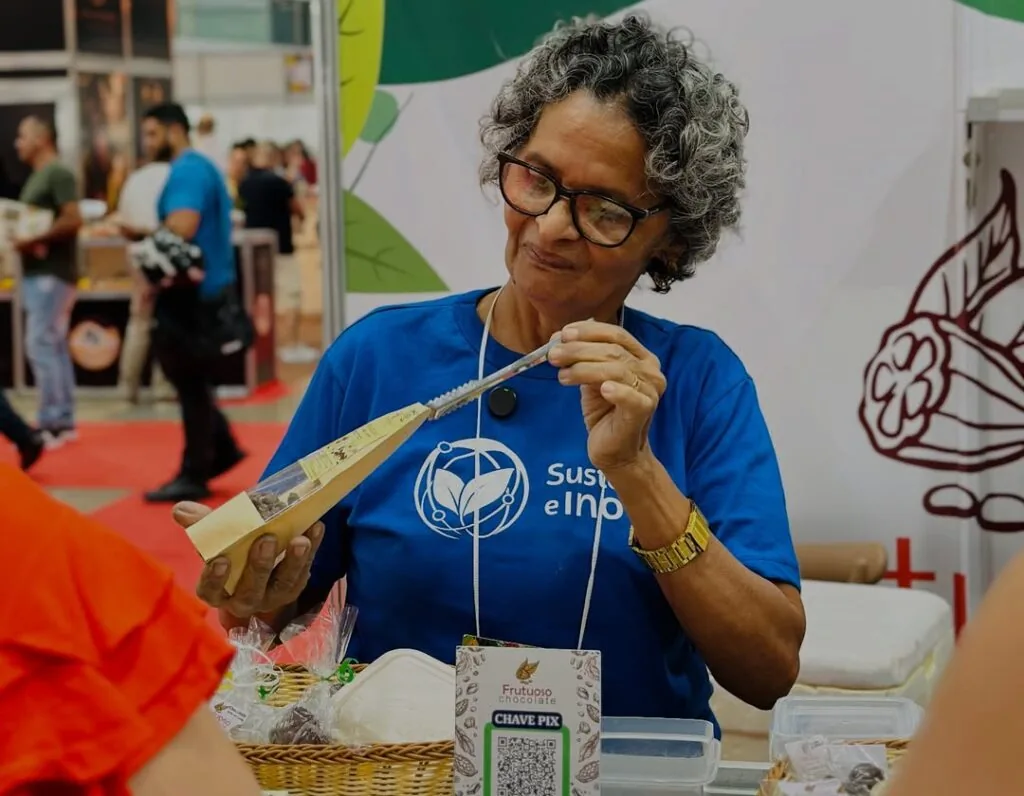
A beneficiary of Sustenta & Inova, the cocoa producer from Brasil Novo (PA), Iradir Frutuoso, shares the growth trajectory of her work, as well as the impact of the initiative’s support on the production development process.
Comunicação/Sustenta e Inova
“It’s been three years since we built the factory, with a lot of effort and dedication, always working with organic cocoa and seeking quality in every product. Our 50% chocolate with coffee is one of the products that most represents this care. Seeing our products gaining ground and recognition is a source of great pride, and the partnerships and support we have received have been fundamental in strengthening and continuing this work,” she said.
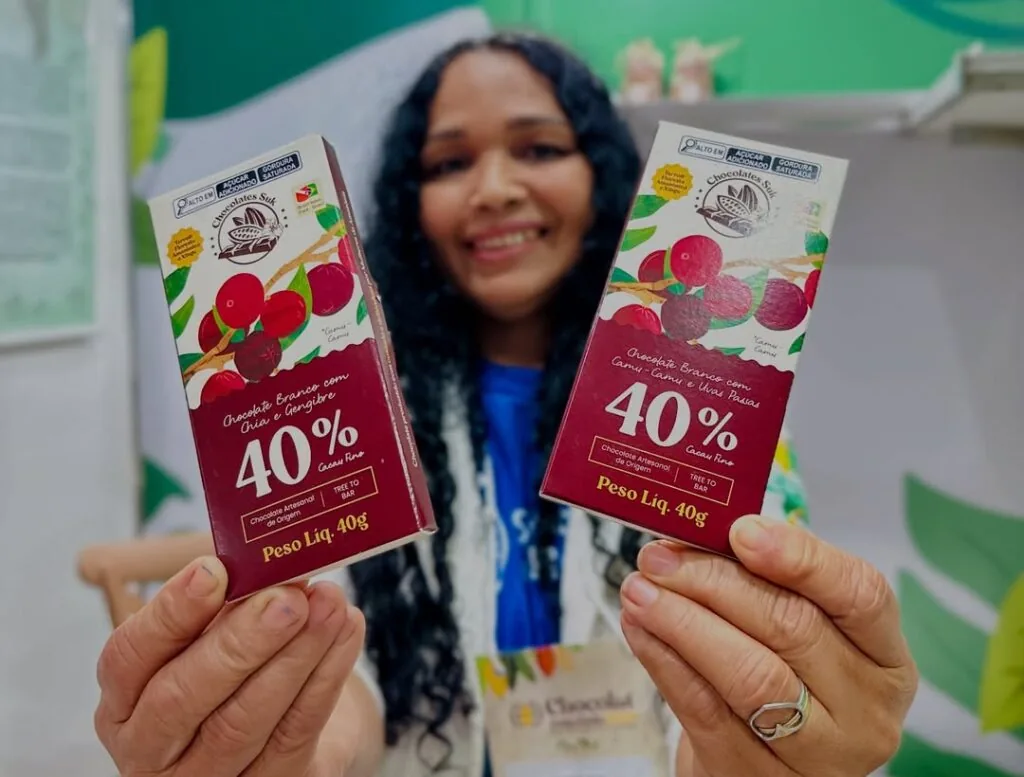
For Cleide SuK, of Chocolate Suk, also a beneficiary of the project, in the municipality of Brasil Novo, the difference in production lies in the valorization of ingredients from the forest.
Comunicação/Sustenta e Inova
“We work with chocolates made from organic beans and also with natural essences such as cocoa nibs and combinations that add nutritional value. Our focus is on offering a quality product that also contributes to the well-being of those who consume it,” he says.
Recognized for integrating different links in the chocolate production chain, the Festival has maintained its aim of bringing producers, specialists and consumers together through activities that combine content, culture and tasting. Held in the capital of Pará, the highlight of this edition was the valorization of regional production and the opening up of space for local initiatives, promoting the circulation of knowledge and strengthening businesses connected to Amazonian cocoa.
The event was supported by the Government of Pará, through Sedap, and Funcacau (Pará Cocoa Support Fund).
Cocoa Forum
The future of cocoa growing in the Amazon was the theme of the 10th edition of the Cocoa Forum, held as part of the Chocolate Festival. It brought together producers, technicians and researchers to discuss challenges facing the chain, such as falling prices and rising costs, as well as ways to strengthen production, with an emphasis on agroforestry systems, diversification and access to markets. IPAM participated with farmers accompanied by the institution, encouraging the exchange of experiences between different territories.
“This is the tenth edition of the Cocoa Forum, in a challenging scenario for the chain, with falling prices, rising costs, high interest rates and external impacts, such as the increase in fertilizers, which affect profitability. It is precisely at these times that the sector needs to come together to build joint strategies and strengthen organization, especially among small producers, to get through this cycle. What we do here is share knowledge, and it’s from this exchange that we can identify challenges and come up with collective solutions,” said environmentalist Marcello Brito.
Cocoa production in Pará
Pará’s leading role in hosting the 10th edition of the International Chocolate and Cocoa Festival helps exemplify the sector’s relevance in the region. According to an IBGE survey (2024/2025), the state has consolidated its position as the country’s leading cocoa producer, accounting for over 47% of Brazilian production. 154,000 tons were produced, as a result of the expansion of the cultivated area and increased productivity, especially in the Transamazon region, a territory directly connected to initiatives such as Sustenta & Inova.
This scenario is also part of a broader movement to strengthen cocoa farming in the Amazon. The northern region already accounts for around 57% of national production, with the state of Pará responsible for most of this volume.
This progress is not only due to territorial expansion, but also to the adoption of more sustainable practices, such as Agroforestry Systems (SAFs), which contribute to maintaining biodiversity, the water cycle and carbon stocks, generating concrete environmental benefits. A study carried out by IPAM shows that SAFs with cacao trees represent a strategic alternative for recovering degraded areas in the Amazon, by integrating agricultural production with forest conservation.
The research also points to ways of transforming these benefits into an economic return for producers. One of the models proposes compensation for environmental services under mechanisms such as REDD (Reducing Emissions from Deforestation and Forest Degradation), taking into account the accumulation of carbon in agroforestry systems. The proposal seeks to create a financing alternative that merges economic viability, social inclusion and environmental conservation.
IPAM communications analysts*