
Leonardo Maracahipes-Santos, a researcher at IPAM, explains why transition zones are unique for science and advocates specific policies for these areas. The interview was published in the newsletter Um Grau e Meio, produced by IPAM (Instituto de Pesquisa Ambiental da Amazônia).
Sign up to receive Um Grau e Meio every two weeks in your inbox.
Having worked in the Amazon-Cerrado transition zone since 2008, Maracahipes-Santos is currently coordinator of the Tanguro Research Station, located in the region, in the north of Mato Grosso.
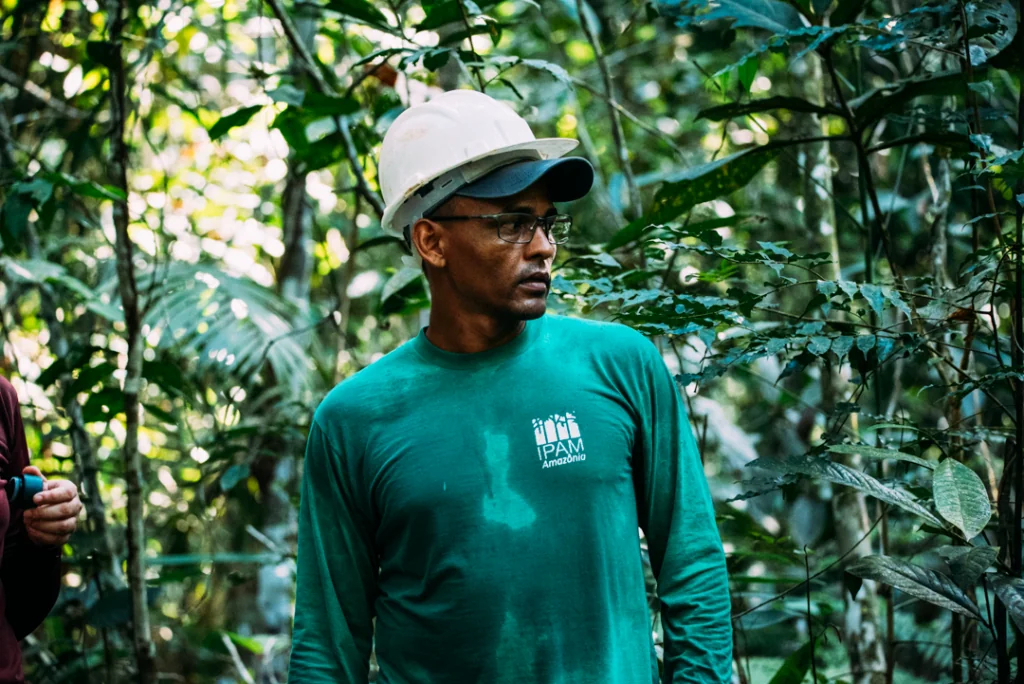
Leonardo Maracahipes-Santos, IPAM researcher and coordinator of the Tanguro Research Station (Photo: Mitch Korolev/Woodwell Climate)
What characterizes a transition zone?
It is an area that overlaps the characteristics of both biomes, in this case the Cerrado and the Amazon. Because it has characteristics of both biomes, it is an area of high environmental heterogeneity and high biological diversity.
This transition zone creates environments that can be found there and that support specific species, mainly fauna, because of the edaphoclimatic [climate and soil] conditions.
How important is the Amazon-Cerrado transition zone for research?
Within the transition zone, the Cerrado areas have a striking characteristic which is the presence of fire, while the forest areas in the transition have no fire. There is a very diverse mosaic of forests, of high ecological importance, in which we can study the coexistence of biodiversity between the Amazon and the Cerrado, as well as the carbon stock.
There is also the role of connectivity between landscapes, which serves mainly for the movement of fauna and gene flow – which are the genetic characteristics of individuals of the same species. This is very important for the evolutionary part of species, because without gene exchange within populations, the species is heading towards extinction.
Finally, the transition zone has an influence on climate regulation, both locally, by improving the climate for the people who live in the region, and regionally and globally by controlling temperature and rainfall.
Are there specific policies to protect the region?
Not that I know of, but there should be. The Amazon-Cerrado transition zone is very specific and is exposed to pressure from agriculture. We still need to invest in implementing and enforcing the Forest Code in the region, not to mention validating the CAR (Rural Environmental Registry).
The fact that it is a very sensitive area also increases the risk of endemic species becoming extinct, something that may already have happened without us even knowing it, since there are rare species that occur only in these regions.
What impacts are already being felt as a result of the loss of native vegetation in the Amazon-Cerrado transition zone?
We have the example of disappearing springs. Here at the Tanguro Research Station there are some streams that didn’t dry up until 2019, they were continuous, now they’re not and they’re drying up every year.
What’s left for the future?
The Amazon-Cerrado transition zone is a natural laboratory for understanding both vegetation responses and the effects of climate change over time. That’s why long-term research projects are important.
It’s a dynamic and rapidly changing region, especially with the current frequency of extreme weather events, droughts with shorter intervals, changes in rainfall patterns… This transition zone is directly linked to our future.
Protecting it, therefore, means protecting the very capacity of the Amazon and the Cerrado to resist these changes that are underway.
One example of what could be done is in relation to research calls: some calls focus on a specific biome and this is something that could be done for the transition zones too.
These are important areas, which are included in these broad calls, but because there are not enough resources available, they end up focusing on groups studying either the Amazon or the Cerrado, not both.
That’s why research calls focused on transition zones in all biomes would be a great way to stimulate knowledge about these little-studied and poorly protected areas.