By Mayara Subtil*
The Bonn climate negotiations came to a close on Thursday (the 18th), consolidating progress on one of the key political legacies left by Brazil’s presidency of COP30: the development of a global roadmap to curb deforestation and forest degradation by 2030. Over the course of two weeks, governments, scientists, civil society organizations, and international bodies engaged in in-depth discussions on the document, which is expected to be presented before COP31. This progress was achieved despite the deadlocks that marked the end of the conference and prevented consensus on central issues of the climate agenda, such as mitigation, adaptation, and measures to address climate change.
Six months after COP30, the Bonn Conference [or 64th Session of the Subsidiary Bodies] served as the main forum for in-depth technical discussions on climate issues held in Brazil in 2025. The meeting brought together representatives from nearly 200 countries to advance issues related to the implementation of the Paris Agreement.
Although the roadmap document is still being drafted, the Bonn meeting served to refine proposals and gather contributions from different sectors of the international community. According to Ludmila Rattis, a researcher at IPAM (Amazon Environmental Research Institute) and the Woodwell Climate Research Center in the United States, the climate meeting in Germany marked a decisive step in refining the global roadmap focused on forests.
“There has been significant progress both in terms of what we are proposing for the roadmap and the document itself. We held discussions with governments, UN [United Nations] agencies, civil society organizations, and various international networks. The debate is intense,” she said.
Through a series of formal and informal meetings led by the COP30 presidency, discussions surrounding the roadmap to end deforestation and forest degradation were among the topics that most engaged governments, scientists, civil society organizations, and international bodies in Bonn. The proposal aims to develop a set of guidelines capable of accelerating the implementation of actions aimed at protecting forests by 2030. The document brings together contributions from governments, scientific institutions, indigenous peoples, traditional peoples and communities, the private sector, and civil society to strengthen strategies for conservation, restoration, financing, monitoring, and forest governance.
According to Ludmila Rattis, the Bonn meeting also helped consolidate common ground on the key elements that should form the basis of the proposal. These include the conservation of priority areas, the restoration of degraded ecosystems, the strengthening of monitoring and transparency systems, the expansion of climate finance, and the recognition of the strategic role of indigenous peoples and local communities in forest protection.
The discussions also reinforced the need to link the forest agenda to other strategic issues, such as economic development, international trade, agriculture, and climate finance, recognizing that forest protection depends on broader transformations in production, consumption, and investment models.
The process is expected to continue advancing in the coming months across various forums on the international agenda, including the London and New York Climate Weeks, as well as the COPs on Desertification in Mongolia and on Biodiversity in Armenia, leading up to the final presentation of the document before COP31.
Fossil Fuels
The COP30 presidency also continued discussions on the roadmap for the transition away from fossil fuels, a policy initiative also launched in Belém with the aim of supporting countries in implementing the commitments made at climate conferences and accelerating the reduction of dependence on oil, gas, and coal.
The two processes are viewed as complementary agendas. While the forestry roadmap seeks to accelerate actions to combat deforestation and ecosystem degradation, the document on fossil fuels aims to identify ways to reduce global dependence on polluting energy sources.
The issue is also expected to take new turns during London Climate Week, when Colombia and the Netherlands are set to present a report based on discussions held at the Santa Marta Conference on the transition away from fossil fuels.
“Spirit of Cooperation”
During the final plenary session in Bonn, Ambassador Liliam Chagas, Brazil’s chief negotiator and director of the Climate Department at the Ministry of Foreign Affairs (MRE), emphasized that the main challenge in the coming months will be to preserve the political momentum built in Belém.
“It is essential to preserve the integrity of the political package agreed upon in Belém and ensure the implementation of all its mandates, initiatives, and commitments. The challenge now is to transform the consensus reached at COP30 into concrete results, keeping alive the spirit of cooperation and ambition that characterized the negotiations,” she stated.
Liliam Chagas also highlighted the importance of climate multilateralism and of “preventing discussions from focusing solely on procedural issues,” directing efforts toward topics capable of generating concrete results. The negotiator also highlighted the progress made in areas considered strategic for climate implementation, such as transparency, international trade and climate, scientific research, gender equality, just transition, and climate finance.
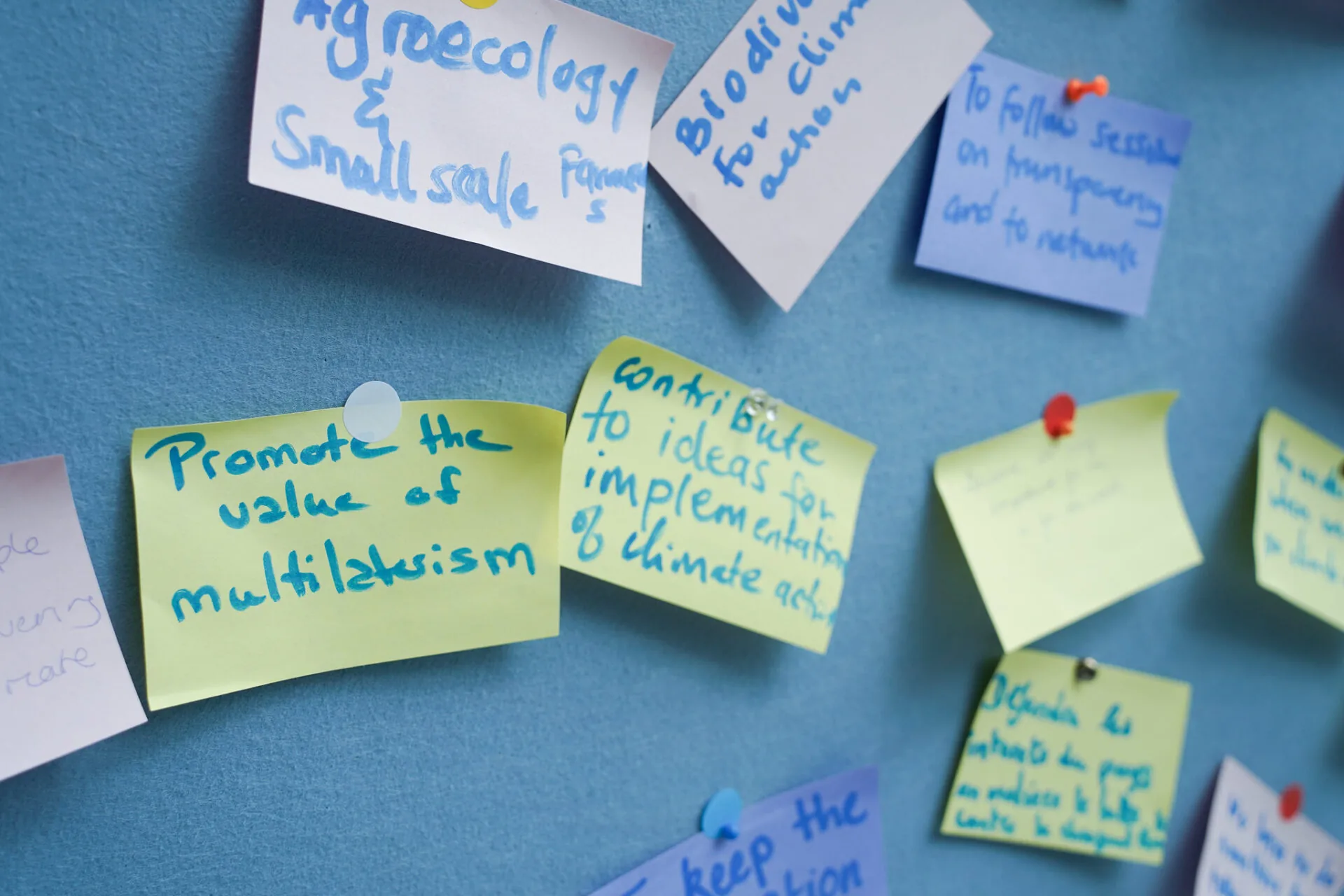
Panel displaying messages on multilateralism and implementation (Photo: Lara Murillo/UN Climate Change)
Among the topics emphasized by Chagas were the Global Implementation Accelerator, an initiative aimed at fulfilling the climate commitments already made by countries; the 1.5°C Mission, created to mobilize governments and non-state actors around the goal of limiting global warming to 1.5°C; and the Baku-Belém Roadmap, an effort that seeks to mobilize US$1.3 trillion in climate finance to support developing countries in implementing climate change mitigation and adaptation actions.
Emissions Reduction
Another issue that saw progress in Bonn was the implementation of Article 6 of the Paris Agreement, which establishes mechanisms for international cooperation aimed at reducing greenhouse gas emissions. A significant part of the negotiations focused on building the institutional infrastructure necessary for countries to effectively put these instruments into practice. The discussions ranged from operational rules to the need for financial and technical support to ensure the participation of different nations in these mechanisms.
According to Marília Oliveira, a researcher at IPAM, the discussions highlighted that many countries still face difficulties in implementing the instruments provided for in the agreement due to a lack of technical, institutional, and financial capacity.
“There was a consensus that many countries still need to build the necessary infrastructure to implement these mechanisms. For this reason, the discussions focused on the need to secure financing, international cooperation, and technical support to make this implementation possible,” explained Marília.
Negotiators also discussed ways to strengthen the so-called non-market-based approaches outlined in Article 6.8, expanding international cooperation instruments that do not depend on the trading of carbon credits.
International alliances and integrated fire management.
International alliances and integrated fire management
Bonn also served as a forum for strengthening new international alliances focused on climate action. In a partnership considered strategic for expanding cooperation among countries in the Global South, IPAM signed a memorandum of understanding with PACJA (Pan-African Climate Justice Alliance), one of the largest civil society networks dedicated to climate justice on the African continent.
The agreement provides for the exchange of information, the development of joint research, capacity building, and collaboration with governments and the private sector, bringing together experiences from the Amazon and various African regions that face similar challenges related to climate change, environmental conservation, and sustainable development.
Another highlight of the conference’s side events was the debate on integrated fire management as a tool for climate mitigation and emissions reduction. At an official SB64 event, representatives from governments, UN agencies, scientists, indigenous peoples, and civil society organizations discussed ways to expand the implementation of solutions aimed at preventing and managing forest fires.
The discussion built on the Call to Action for Integrated Fire Management and Forest Fire Resilience, launched by Brazil on the eve of COP30 and currently supported by 67 countries and four international organizations. The focus was on expanding international cooperation, financing, and governance mechanisms capable of transforming local experiences into public policies on a global scale.
Impasses and COP31
Progress on the forest and fossil fuel roadmaps occurred amid a landscape of obstacles in the formal UN negotiations. The final day of the conference was marked by deadlocks on central issues of the climate agenda, such as the MWP (Mitigation Work Program), the GGA (Global Adaptation Goal), and measures to address the effects of climate change. These disagreements led to successive postponements of informal consultations and forced delegation heads to take charge of negotiations on the pending issues. Even so, no substantive agreement was reached on these topics by the official close of the Bonn conference.
The lack of consensus sparked expressions of frustration among governments, civil society, and observers. Participants criticized the resistance of some delegations to more explicitly incorporating scientific evidence regarding the need to maintain the goal of limiting global warming to 1.5 °C, as well as the lack of significant progress on the mitigation and adaptation agendas.
In a statement released after the conference concluded, the Executive Secretary of the UNFCCC (United Nations Framework Convention on Climate Change), Simon Stiell, acknowledged that, despite progress in some areas, Bonn failed to deliver results on mitigation and adaptation and criticized the stance of countries that make their commitments contingent on prior action by others, describing this dynamic as a “recipe for paralysis” in the negotiations.
“We have seen some setbacks, delays, and geopolitical tensions run through these negotiations. We cannot allow setbacks or reopen commitments already made, because that is a recipe for paralysis precisely when we need all negotiation fronts to move forward at a rapid pace,” Stiell stated.
COP31 will take place in November in Turkey (Photo: Lara Murillo/UN Climate Change)
Throughout the negotiations in Bonn, Australia and Turkey—which will hold the presidency of the next conference—reiterated that the meeting will focus on the implementation of the climate commitments already made by countries. Despite this, the two governments concluded the meeting without presenting broad policy priorities or initiatives capable of providing clearer direction for the negotiation process in the coming months.
The main announcement was a voluntary target to increase electricity’s share of global energy demand to 35%—that share currently stands at around 20%. The proposal was launched as part of the COP31 Action Agenda.
In Bonn, COP31 also announced targets related to reducing the growth of waste generation, increasing the circularity of materials in industry, improving energy efficiency in urban buildings, promoting climate education, and creating the so-called Climate Implementation Bridge, a mechanism developed in partnership with the UNDP (United Nations Development Program) to facilitate access to financing, training, and technical support for the implementation of climate actions.
*IPAM communications analyst. mayara.barbosa@ipam.org.br