Regenerative agriculture has been gaining ground in debates in the environmental and agricultural sectors as an alternative for long-term sustainable rural production.
Given that rural productivity depends on the ecosystem services offered by nature, and that climate change caused by human action is increasingly damaging planting and harvesting, the opportunity to change course is knocking at the door, signaling a path of agricultural practices allied to conservation.
This week’s Um Grau e Meio (One and a Half Degrees) interviews Ludmila Rattis, a researcher at IPAM and the Woodwell Climate Research Center, about the possibilities of regenerative agriculture in the context of Brazilian agriculture.
Sign up to receive IPAM’s newsletter for free in your e-mail.
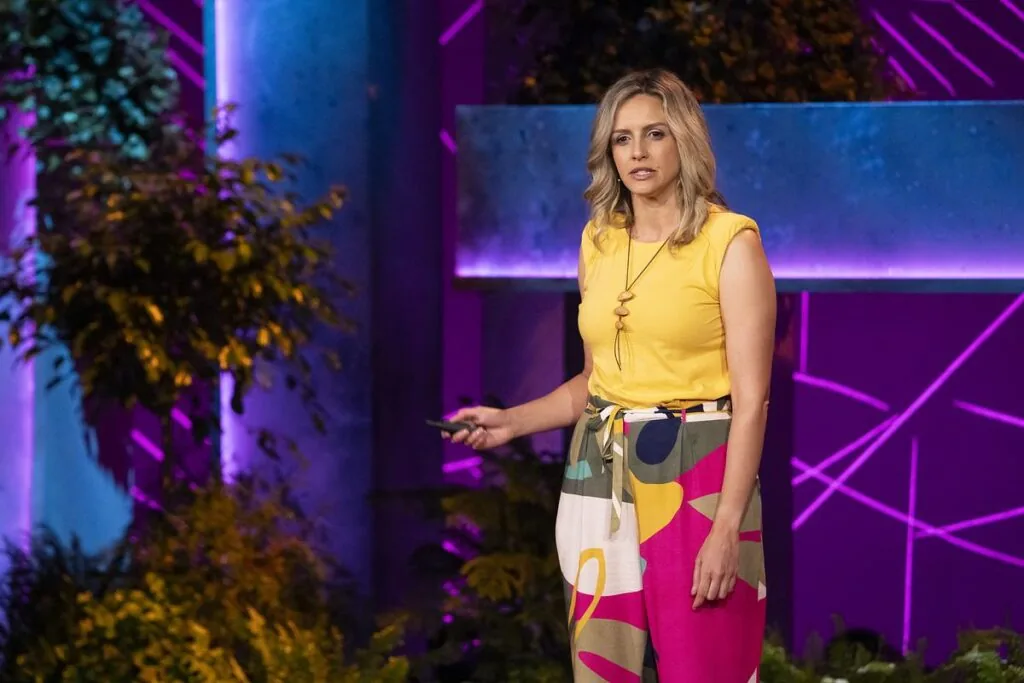
Ludmila Rattis speaking at TED Talks (Photo: Nick Hagen/TED)
In your research, what impacts have you observed in the agriculture-forest relationship? Have any cases caught your attention?
One of my first jobs when I joined IPAM 10 years ago was talking to farmers in the field. On one occasion, a field manager pointed out to me that he saw a dichotomy in the forest-production relationship, for example, cotton trees were more productive near the forest, but other crops would be more attacked by insects and pigs. After all, was the presence of the forest an advantage or a risk?
In addition, we began to wonder whether the influence could extend beyond just a few meters. So we ran analyses to find the scale of the effect, using circles of different radii to understand the relationship between soy productivity and the amount of forest at the landscape scale. Thus, we saw that the scale of 30 km radius is the most appropriate for the Amazon region, and for the Cerrado region it is 55 km – but we are still investigating.
Nobody plants forests to increase productivity. You add fertilizer, pesticides and insecticides and try to plant in good soil. That’s because the agronomist’s productivity model is based on climate, soil and management. And that’s fine.
What was innovative about IPAM’s work was that by including ecological variables, such as the presence of the forest, we investigated and discovered that the role of the forest – in the sense of forest phytophysiognomy – is much more important than previously thought. And that seems to be a very Brazilian jaboticaba. Or Amazonian, I should say. But I ask you: is it luck or bad luck that we depend so much on the forest as part of our productive infrastructure? If we live in a world that sees the forest as the asset that it is, that’s a sign of luck, a lot of luck.
Another important surprise was the discovery that the agronomic-ecological model of agricultural productivity was much better at explaining soybean productivity than a purely agronomic model. These results will be published in a scientific article by the end of the year.
The more forest there is, the more productivity. This effect is not going away. If it’s a very dry El Niño year, the role of the forest becomes even more important, both to prevent loss and to increase and/or maintain productivity. We’re seeing this in the field. There are producers who work with landscape management and manage to maintain productivity in a bad El Niño year. Anyone who neglects the landscape loses. And they lose a lot, sometimes everything.
Is regenerative agriculture enough to solve the problem?
Here comes the question of what kind of regenerative agriculture we’re talking about. It has to be a landscape-scale approach. Plot management doesn’t solve the climate crisis.
Since we have a law protecting native vegetation in Brazil, we have to use this to the agricultural sector’s advantage in order to think about mitigation and, why not, adaptation.
With this concern in mind, we are writing, in a group of farmers, policymakers, economists and researchers from different institutions, another scientific article to deal with the definition of tropical regenerative agriculture. There are some pillars, for example, keeping the soil alive and the biogeochemical cycles, as well as biodiversity and the management of the integrated agricultural system. But the forest is part of the productive infrastructure, as productivity models show.
This regenerative agriculture, with pillars and premises, in a scalable way and with incentive design, can solve this problem. Regenerative agriculture that only talks about cover crops, crop rotation, no-till farming and intensification does not.
The Cerrado is home to most of Brazil’s agribusiness and most of its remnants are inside farms. Is increasing the legal reserve in the biome a viable option?
Before we talk about that, we have to talk about protecting the surpluses that are there. I say this even for the sake of producer safety, because standing native vegetation is climate resilience in the landscape, it’s air conditioning.
If we’re looking at the possibility of a strong El Niño, are you going to sell your fan, your air conditioner that you have at home? We don’t do that at home, with ourselves, so why are we going to do it with the farms?
We need an incentive system so that, before we talk about increasing legal reserves, we talk about increasing the protection of what can be deforested. Talking about increasing legal reserves doesn’t help build the bridges we’re trying to build.
Sustainability has been on the agenda of the agricultural sector for years. What progress has been made and what challenges remain to be overcome?
I’m going to say that we used to have very strong climate denialism in Brazil as a whole. Nowadays that number is very low.
In the beginning, we didn’t talk, people who were more pro-protection, others who were more pro-compliance with the law ipsis litteris or those who were against the law… Nowadays we’re trying to reach a common denominator. That’s better than losing everything you have, even if it’s non-negotiable.
But we need to follow the scientific consensus. Our role is to speak out. You can discuss the Forest Code as a law, but you can’t discuss the law of biophysics.
There isn’t a tree that says ‘since I’m legally falling here, I won’t have the impacts of deforestation’. One tree falling means 300 liters of water stop circulating every day. It’s an energy equivalent to two air conditioners that stop dissipating every hour. The land becomes dry and feverish.
We’ve left a very bad point, but we’re doing even worse than the most pessimistic models said in terms of climate change. We’re going to have to absorb the consequences, of which there are many. We still have a long way to go, most of the way is ahead of us.