
Karla Martins, or @karlotadoacre, is an actress from Acre with a degree from Unirio (Federal University of the State of Rio de Janeiro) and a postgraduate degree from the Instituto Superior de Arte in Havana, Cuba.
A storyteller, cultural and environmental activist, she spoke to the newsletter Um Grau e Meio, from IPAM (Amazon Environmental Research Institute) about how myths and legends help us to see ourselves as part of nature.
Sign up to receive IPAM’s newsletter for free in your e-mail every other Monday morning.
Karlota is an organizer for the Chico Mendes Committee, and the founder of Mídia Ninja, Casa Ninja Amazônia and the Fora do Eixo movement. She was a teacher in rubber plantations in the state of Acre, where she learned that storytelling is a collective process.
Her work at the interface between culture and the environment has led her to be in demand for national audiovisual production. During the interview, she was in Pucallpa, Peru, working as a producer on a film that will be set in the cross-border Amazon.
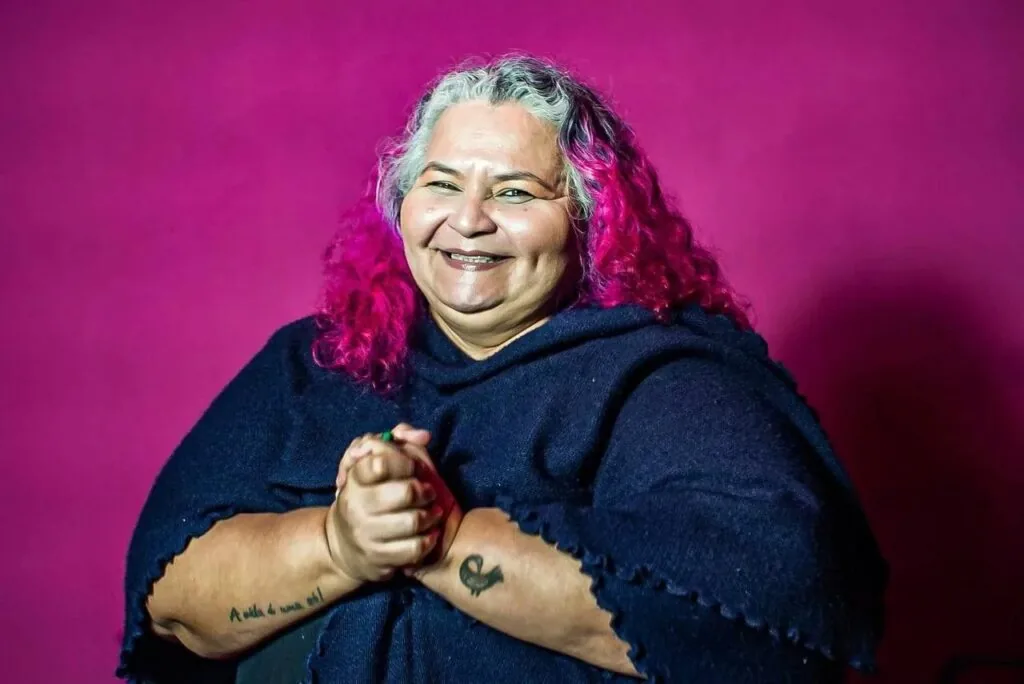
Karla Martins, actress and environmental activist, is interviewed in the newsletter Um Grau e Meio (Photo: Mídia Ninja)
Tell us a bit about your work and your relationship with storytelling.
Because I was born in Rio Branco, Acre, but also lived for a time in Rio de Janeiro, I came to understand, without knowing exactly what we call it today, what a place of speech is.
There is a view in Brazil that everything that has quality in culture needs the approval of the Southeast. For a long time, those of us who lived far away suffered a lot of prejudice when we went to the big cities. Less so today.
After spending 10 years away from Acre, when I came back, I began to understand the strength that we have in the territory and that was very little recognized.
I became a teacher in the rubber tapper project schools and got to know the teachers and the processes of orality. I’m the daughter of a rubber tapper mother, a rubber tapper grandfather, this is in my family.
So I came across the stories, beliefs and popular wisdom. If it has a name, it’s because it exists: I no longer call it a legend. If I’ve heard a story about Mapinguari, Caboclinho da Mata… if you’re asking me, it’s because it exists. The forest speaks to those who know how to listen.
What does it mean to tell a story?
In the past, at school, we used to learn that a story with an H was a “true story” and a story with an E was a “lie”. But even the story with an H was written in lies. So everything is a story.
What we’re doing now is history. We all have our references and that allows us to tell. The storytelling movement talks about this a lot. There’s no specific theme, anyone can tell a story and it’s important to bring the process of orality into our society today.
Storytelling is a part of humanity. We have this code among us, a literate code. But indigenous peoples teach us that orality is the value of the word, what the person tells us, and this is very important. It’s something to think about. Storytelling is a collective act.
Where do the stories you tell come from?
I tell what I believe in. As Angela Mendes, daughter of Chico Mendes, says, if you want to talk about the Amazon, call us. We have a lot to tell about ourselves.
The most important thing to think about is that when you tell a story, you see a collective process. ‘I’m from here but I’ve come a long way, telling stories on a big boat. There’s a brunette rose and a verbena to adorn you. They are flowers of flesh and blood, from my neck to your necklace’.
I sing and say to people, depending on the story: ‘How long has it been since you’ve heard a story? How long has it been since you sat in a circle, with your heart open, to listen to what someone is telling you?
“I’ve come here to tell you that you need to remember a tree, because we all have a tree inside us. That tree you used to draw on, that you climbed to play with, a tree you saw in bloom. Trees teach us something, because they like to live close to each other, protecting and caring for each other. I wish you to remember your tree, to be a tree. Feel where you’re rooted, feel the canopy above you, the shade… and that’s how I’ll tell you a story’.
How is the relationship with the listener?
If we hadn’t lost the real thought that being together is good, that living collectively is good, we would have the forest and nature better cared for.
I’m working on the orality room for a museum that’s opening in Belém, the Museum of the Amazon. At a meeting, they said that the maximum concentration time people have today to visit a museum is 17 minutes. I laughed.
When I was teaching in the rubber plantations, a very old person said to me: ‘Sometimes I talk for two or three hours and stop. It depends on how much the kids are looking in the corner. Then I stop, tell everyone to drink some water and come back, so that I’m the main focus again.
People have a place of concentration. In cities, technology has lost a lot of that. But I’ll tell you clearly, whether in the countryside, in the city, on indigenous lands or in communities, when you say ‘once upon a time’, people stop. The idea of listening is still in the human being.
Even telling a story to just one person makes sense. Sometimes when I go to nursing homes, I tell the funniest stories. It’s a twinkle in the eye.
How does nature come into the story?
Nature speaks to those who know how to listen. You need to think about that when you tell stories. Celebrate the word as something very important. The act of patience. The thing I’ve learned most from indigenous peoples and traditional communities is patience, taking the time to look at what’s around you.
At that time I was still walking, sometimes 26 hours. It took days to reach the allotment. I used to walk with a rubber tapper and once I said “it’s so green that we get tired of looking at it”, and he said “no, it’s not. It’s light green, dark green, there’s brown, gray. When it’s in flower, sometimes it’s red, purple.
My gaze was full of vices. The forest isn’t just one green, it’s multicolored. You have to open your eyes and patience does that.
Sometimes I say: “Everyone learns at school that the Amazon is the lungs of the world, but that’s wrong. The Amazon is the air conditioning of this planet. And because it cools the planet, it also gives us the idea that we could cool our minds and hearts to think about future possibilities for life. That’s why we also tell stories.
What role does stories play in environmental protection?
Telling stories and making this interface with the environment has to do with the organic thinking that the environment and people are all the same. We’ve stopped seeing ourselves as the environment. As much as I now feel that people are raising this issue, we still see ourselves only as people.
There was a moment when we ejected ourselves from thinking about the environment. We started thinking about humanity and created an arrogance to maintain ourselves, that we are more important than anything else. As a result, we lost the sense of protecting the whole. But when I protect the environment, I protect everyone around me, I protect life and the world.
Society began to establish dynamics in which you have to be the best, and if you’re not the best, you don’t succeed. This social systemic thinking has put this into our heads and even taken away the idea of collectivity.
But the conservationist myth of the standing forest doesn’t exist. Where there is standing forest, there are people taking care of it. A friend of mine, Antônio Alves, a thinker from Acre, coined the word florestania, which people understand as the citizenship of the forest. When you have the idea of collectivity, you understand the forest, because the forest is a collective place.
Sometimes, what seems like modernity can also be a way of killing the thinking of a people, a community, a place. How long have we called indigenous people backward? How long have we used the words ‘Indian’ and ‘rubber tapper’ to disqualify timid people?
Everyone has their leaves. Everyone has a tree inside them. If everyone remembered their tree, maybe that would be the first step towards getting out of this climate agony we’re experiencing. It’s a way of calling people to this place of listening to history, to nature, to what’s inside you, much more like a call.
Cover photo: Mídia Ninja