
By Bibiana Alcântara Garrido*
In this fortnight’s edition, the newsletter Um Grau e Meio, from IPAM (Amazon Environmental Research Institute), interviews Ivan Gonzalez. He is a member of the political committee of the People’s Summit, made up of Brazilian and international organizations. Gonzalez is also the Political Coordinator of the CSA (Trade Union Confederation of the Americas), a continental trade union organization that represents the trade union federations of 21 countries, from Argentina to the United States.
Sign up to receive the IPAM newsletter in your inbox. It’s free!
The next People’s Summit takes place from November 12 to 16 in Belém, during COP30, the United Nations climate conference. The movement brings together more than 1,200 national and international organizations around the issue of climate justice. According to the organization, it is one of the most important mobilizations of recent years.
Check out the People’s Summit website for the full program and the manifesto. And to keep up to date, just follow the Summit’s Instagram profile.
In addition to the activities that will take place in rooms, auditoriums and tents at UFPA (Federal University of Pará), the Summit will take part in events throughout the city and will also have representatives in the official COP30 negotiating spaces.
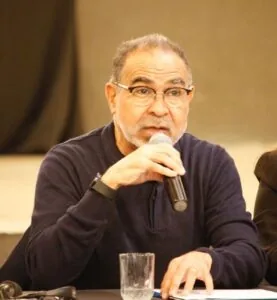
Ivan Gonzales, member of the Peoples’ Summit political commission (Archive/Reproduction)
The movement is also scheduled to meet with André Corrêa do Lago, president of COP30, on the 16th. On that occasion, a declaration with demands and solutions from the world’s workers and communities for the climate emergency should be delivered: “This is what the People’s Summit is: the coming together of all the international people to say that we are here; we have answers, demands and we want to be part of the solution,” says Gonzalez.
Read the full interview.
What is the People’s Summit?
It’s not a new invention. It has always been an instrument, since the self-convocation of social, trade union and popular movements, which build agendas in the face of official processes. It can be at the COPs, the climate conferences, but also in other spaces. The previous one in Brazil was the People’s Summit ahead of Rio+20, where we brought together 30 debates on the environmental agenda and built a counterpart. We are the peoples facing the official meeting. We have held many Summits at other times
This, in particular, is the most important mobilization in recent years. Because the previous COPs were held in countries where democracy doesn’t work, there’s repression, criminalization of trade unions and social movements… that’s why the Belem Summit is so important. COP30 is being held in a democratic country, which allows for social mobilization.
It’s our space to talk about what we’re doing to tackle the climate crisis, as well as measures that governments have to take, so that it’s not the workers and communities who pay for the crisis, because the crisis is not generated by the people, but by capitalist activities.
This is what the Summit is about: bringing together international people from all over the world to say that we are here, we have answers, we have demands and we want to be part of the solution.
Who is organizing the Summit?
This Summit in Belém has more than 1,200 national and international organizations taking part. They are trade unions, affected communities, peasant organizations, environmental organizations, feminist organizations and many other types of organizations.
We are organizations from Latin America and the Caribbean, the United States, Canada, Europe, Asia, Africa… it’s a diversity of sectors and regions of the world, of languages, cultures and activities. It’s a combination of the diversity of what the planet is, because the world is that reality. Trade unions are part of it, of course, but so are multiple organizations from other sectors, such as native peoples and fishermen.
What is the main message that the Summit wants to convey?
The central message is that there has to be climate justice. That the climate crisis should not be paid for by the people, especially the poorest people in the world.
The responsibility lies with the Global North, with the rich economies of the planet, with the transnational corporations. And we, the peoples, are demanding that justice be done. This climate justice means that the response to the crisis has to be with the people. The main task of states, of governments, is that the consequences of the climate crisis are not paid for by those who caused it the least.
Within this, we have several points, for example, the just transition is a demand, talking about workers’ rights, health, education, it has to be part of the response to the crisis. This implies the participation of workers in the response to the energy transition, the change in the way rivers and land are exploited in certain activities.
There is also the demand from the People’s Summit for the debts that are being incurred. For example, who will pay some form of compensation to the communities affected by mineral exploitation? For oil exploitation? These communities have to be compensated for the impact caused by economic activities that exploit nature.
Another demand of the Summit is that in order to tackle the climate crisis we must stop investing in war. An exorbitant amount of money is being spent on weapons for supposed wars. This could be invested in solving the problem of the climate crisis in various regions of the world. One of the central messages of the Summit will be the commitment to peace and an end to imperialism’s wars and aggressions against the peoples of the world.
We also argue that the negotiations to tackle climate change cannot be, as they are being, captured by the main polluters.
The main decision-makers are not the states, the governments, let alone the people. Who is deciding where we are going are the companies, the big transnationals in the polluting sectors, such as oil companies, mining companies, big companies that occupy the planet’s fresh water. These big companies are influencing the climate negotiations and deciding how far the commitment goes.
We demand that the climate negotiations cannot be captured by big companies and must be led by states. And in this dispute over who leads, the states of the Global South, who are suffering the consequences of the climate crisis, should have a say in the negotiations. It can’t just be the countries of the North that determine what has to be adopted, because it’s a totally unequal relationship; they are the main polluters and the people who pay for it are the people of the South and the excluded poor in the countries of the North.
Does the Summit intend to launch any documents during COP30?
For more than a year, we have been organizing the possible consensus within our diversity of realities. On the 13th and 14th, we’re going to have plenary sessions on the six priority axes, in which we’ll present the debates and the accumulated experience of diagnosing the reality of the climate crisis, as well as our alternatives. On the 14th, at the end of the afternoon, we will adopt a summit declaration, which will be our manifesto for positioning ourselves in the negotiations.
We’ll have a Global Day of Action, with a call for November 15 to mobilize in Belém, but also in other regions of the world, so that people can get to know our agenda and make our struggles visible. And on the 16th, the president of COP30 will be at the Summit to receive our declaration.
We will also have exchanges in the very spaces where civil society can speak at the COP. We will have our spokespeople, our activities within the COP30 space, in the blue zone and the green zone, to put our demands forward there.
In between, we have a strategy for influencing governments, to put our vision to the negotiators and attract dialogue with the official delegations. We also intend to influence the official negotiations, but our main focus is the People’s Summit.
Where will the activities and main discussions take place? Is the event open?
We have a lot of demand for participation and the structure can’t cope with the demand. Next week we’ll release information on Instagram about how people can take part.
We’re going to have activities in different spaces in the city, in addition to UFPA. There will be different spaces that will work simultaneously and there will be plenary sessions where we bring people together. The 13th and 14th will be closed, but there will be public activities and cultural activities, with activities for children too. The program is already being announced.
In addition to the program from the 12th to the 16th, until the end of the COP we will have a representation of the Summit interacting with the official negotiations.
Our idea is for the Summit to have a legacy that doesn’t end in Belém, it’s a process that continues next year with unitary agendas. Surely, until COP31, we will have continuity in this space. Our idea is that it doesn’t end in Belém and that the legacy of the Peoples’ Summit has projection into the future.
*IPAM journalist, bibiana.garrido@ipam.org.br