
By Bibiana Alcântara Garrido*
The fight against wildlife trafficking is still an issue of little efficiency in the Amazon. Antônio Carvalho, a specialist in the fight against wildlife trafficking at WCS Brasil (Wildlife Conservation Society), is the author of the new edition of the newsletter Um Grau e Meio (One and a Half Degrees), published by IPAM (Instituto de Pesquisa Ambiental da Amazônia).
Sign up to receive IPAM’s newsletter in your inbox every other Monday at no cost.
“The Amazon is still forgotten when it comes to animal trafficking in Brazil. All the police and environmental agencies have the prerogative to act to combat animal trafficking, but as few officials specialize in the subject, trafficking goes almost unpunished in the Amazon. Most of Ibama’s staff are focused on mining and deforestation, which is why the annual maps of environmental crimes don’t reflect the true situation of crimes against fauna,” he says.
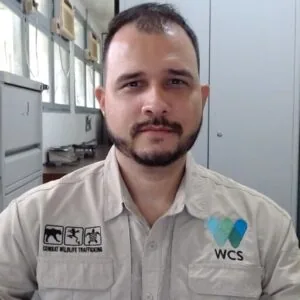
Antônio Carvalho, a specialist in combating wildlife trafficking at WCS Brasil, is interviewed in the newsletter Um Grau e Meio (Photo: Disclosure)
The specialist refers to the Diagnosis of Environmental Crimes, published by Ibama (Brazilian Institute for the Environment and Renewable Natural Resources), which shows the spread of wildlife crimes in the Amazon, on pages 150 and 151.
What are wild animals?
Wild animals are non-domesticated animals that have an evolutionary history independent of human beings and do not depend on people to perform any natural function, such as reproduction. This group is made up of a variety of beings, from pollinating insects, for example, to mammals such as the maned wolf and the jaguar.
Law No. 5,197, of January 3, 1997, prohibits the use, persecution, hunting and destruction of wild animals in Brazil, except on occasions of regional peculiarity that establish permission for hunting by regulation of the federal government.
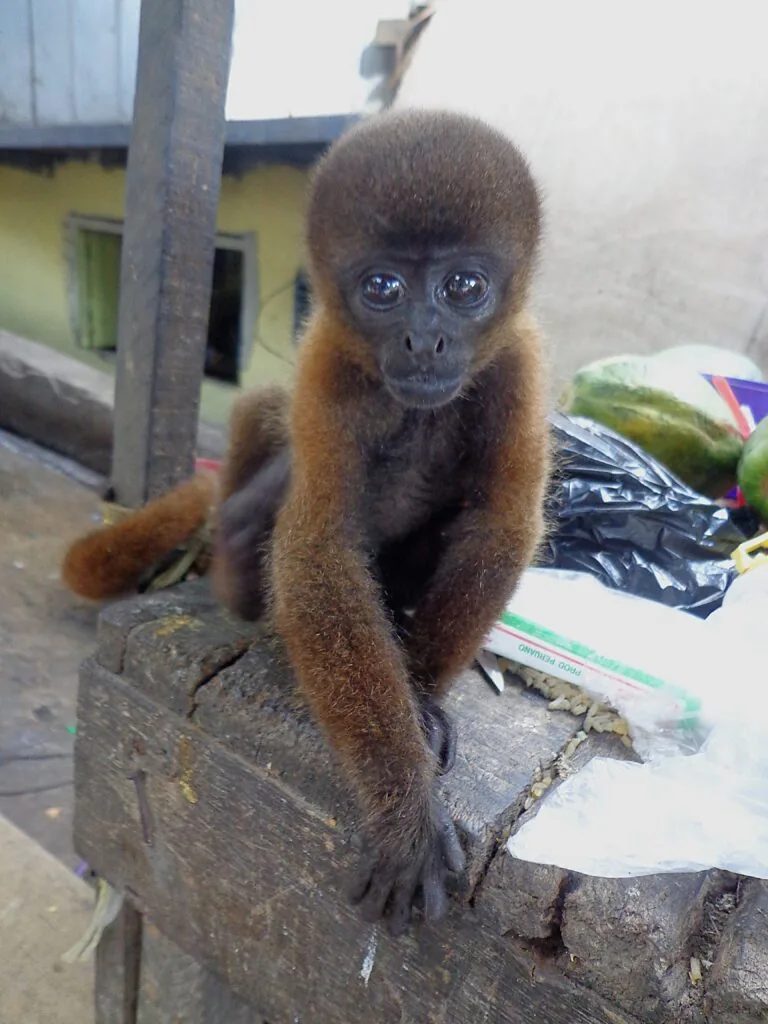
Big-bellied monkey (Lagothrix lagothricha) victim of wildlife trafficking, being sold at a fair in the city of
Wildlife trafficking in Brazil
Carvalho has been working to combat wildlife trafficking since 2019, when he published his first articles in the field. Among the cases that his work has supported – at WCS and before that, at the National Institute of the Atlantic Forest – are reports of irregular trading of wild animals, such as bees, on Mercado Livre and Facebook’s MarketPlace.
“We found advertisements for the sale of bees in closed boxes, going from all over Brazil to other regions where the species is not native, and we reported it in a scientific article. All the ads on the Mercado Libre were taken down, but months later new ones appeared. Our work has raised awareness, by distributing the information, including the platforms themselves. But it comes back, so we can’t lose sight of it. More than specific cases, disseminating information about trafficking routes, promoting a global understanding of the problem in the chain of exploitation related to species, is much more interesting for contributing to police and inspection bodies,” explains Carvalho.
According to the expert, the most emblematic recent case involved an international investigation into joint seizures of the golden lion tamarin and scarlet macaw species in 2023 and 2024. His team was able to gather data from seizures over the last 30 years that showed a recent increase in interest in the two species, alerting us to the possibility that an Indian zoo was the main recipient of this trafficking.
Carvalho also cites as a current case the irregular marketing of shark meat (imported by Brazil from countries such as Uruguay and Taiwan) for consumption in school meals.
“Brazil is the biggest consumer of shark meat: 15,000 tons are consumed every year. Most of the time, these are endangered species, contaminated with mercury. This is meat that we shouldn’t be consuming,” he says.
Specifically in the Amazon, Carvalho highlights the problem of the illegal sale of tracajá and Amazonian turtle meat. The animals, which traditionally serve as food for riverside families and are the second source of protein for these populations, have become a status symbol and are now filling the plates at events in cities like Manaus.
“Turtle consumption is only regulated in the city of Manaus. Around here, we have a few fishmongers who sell farmed fish and turtles. But the challenge lies in washing the animals, because it takes about seven years to have a large animal at the point of slaughter. So the breeders also end up receiving turtles, ready for slaughter, caught in the region,” says the specialist.
How to protect wild animals from trafficking
For Carvalho, the priority is to change the Environmental Crimes Law to make trafficking in wild animals an environmental crime and consider the practice a serious offense, with a penalty of imprisonment.
“Nationally, we have been working to support changes to the law, especially the Environmental Crimes Law, which even today opens up the possibility of the trafficker not being punished; the guy who traffics 200 birds a day is in the same criminal category as a lady who has a parrot at home, for example. We need to change the Environmental Crimes Law to classify trafficking in wild animals as a serious crime, with a penalty of imprisonment,” he says.
Secondly, the expert emphasizes the importance of the competent bodies taking a global view of the environmental crime before determining the penalty and the amount of the fine. Often, for example, the crime of money laundering is linked to drug trafficking, he says.
The third point deals with the conversion of the fine to repair the damage, according to Carvalho, since the species seized in the operations are sent to sorting centers that need these resources to meet the demand.
Each state has at least one CETAS (Wild Animal Screening Center) or one CETRAS (Wild Animal Screening and Rehabilitation Center). In addition to these facilities, there are also partnerships with legal animal breeders, who receive rescued animals and work on rehabilitating them for release.
“There are no more conditions to receive [wild animals rescued from trafficking] because there is no money or space. Rarely do these animals arrive in a condition to be returned to the wild. They should be passing through, but the animals stay there for a long time, recovering, being treated. And the trafficker who has been arrested continues to commit crimes without having to pay the fine, because he doesn’t lose his rights if he doesn’t pay them under the Environmental Crimes Law,” she says.
Fourthly, complementing the previous point, Carvalho argues that the perpetrators of environmental crimes should lose rights – retention of passports and driver’s licenses or the inability to get loans – as already happens in other types of crime, but not yet in environmental crimes.
Mobilization and governance
The expert points out that there needs to be more public debate on the issue, with campaigns and mobilization actions.
“It’s up to us to be in these spaces, not to refuse invitations, to put what’s happening in the media and to campaign. We’ve already carried out actions at eight airports in Brazil, such as the ‘There are journeys that mark lives’ campaign, informing people about animal trafficking and the impact on wild animal populations. These are efforts to raise people’s awareness.
More than that, he stresses that there needs to be a national governance structure for wildlife trafficking, with environmental authorities and law enforcement agencies working together in a trained manner.
Carvalho mentions as an example of the difficulty of maintaining continuous work the change of Federal Police delegates in one of the municipalities where he works: “In one year of work, I dealt with four different delegates on the same border. How can you create a joint work strategy and develop operations in this way?” he asks.
*IPAM journalist, bibiana.garrido@ipam.org.br