Tainá Andrade*
Luís Carlos Gojvscek, 60, is a sculptor and lived exclusively from his trade until he crossed more than two thousand three hundred kilometers, from Porto Alegre (RS) to Alto Paraíso de Goiás (GO), in the Chapada dos Veadeiros, 15 years ago.
The sculptures made by the artist from recycled scrap metal became a problem in his new home due to the accumulation of discarded waste. The solution was to reframe the use of the material.
On a bike ride, Luís found an abandoned shed. Little by little, Luís cleaned up the 3,000 square meter site. As it was a public area, he couldn’t go ahead with his plan to turn it into a recycling space. However, out of the clash emerged the city’s first recycling initiative: the Recicle Alto association and the Coopera Chapada cooperative.
One of the fruits of the association was the Reciclar é preciso initiative. Through it, the Reciclados social currency was created, which exchanges the garbage voluntarily handed in at the shed for social money, which is accepted in Alto Paraíso’s regular stores, pharmacies, supermarkets and building material stores.
In 2024, the initiative employed 26 people in the two projects, Recicle Alto and Coopera Chapada. Approximately 438 tons of recyclable waste were collected, including paper, iron and stainless steel, glass, plastic and tires in Alto Paraíso, Cavalcante and Colinas do Sul. In an interview with Um Grau e Meio, Luís Carlos Gojvscek tells us how this idea was consolidated.
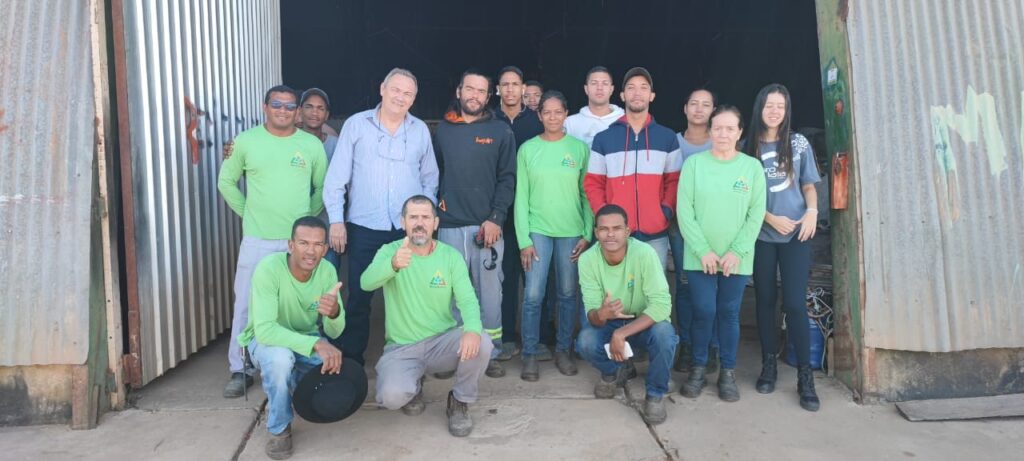 Luís together with the team from the Recicle Alto Association and the Coopera Chapada cooperative. Credit: Recicle Alto collection
How did the idea of starting a recycling cooperative come about?
I used to be a locksmith and ended up becoming an artist. I used to make sculptures out of recyclable materials in Porto Alegre (RS) and ended up becoming well-known. I had a lot of exhibitions and sold a lot of pieces made from scrap.
In 1986 I read a magazine that talked about esoteric things, about Alto Paraíso, and that aroused my curiosity. I took the car, brought the family to see it and fell in love. Then we moved there. I was 45 at the time, it was the right time.
I continued with my handicrafts, opened a store and started recycling there. As I used scrap metal, it accumulated and I had to find somewhere else to put it.
Riding my bike with my son, I found a shed, about 3,000 square meters in size. It was abandoned and I thought it was wonderful. It took between two and three months to clean it up.
When it was not long before it was finished, a commission from the town hall showed up and banned me from using the place because it was a public area. I said I wanted to do a recycling project, but they were right because it was a public area.
From then on, I tried to figure out how I could use the shed. I went to a lawyer and he advised me that the only way to occupy the space was to set up an association. That’s how Recicle Alto came about.
What was your aim when creating the project?
I work with environmental education and I believe that the most difficult recycling to deal with is human recycling. When we understand that the biggest problem is not outside us, but inside us, we have to recycle ourselves as human beings, understand that we are the planet. That’s the great thing.
People talk about religion and forget something so simple and important: that we are the elements of the planet. Our body is 70% water, we can’t do without air, without soil, without the elements of nature. In order for us to understand the need for change, we have to understand that the way we treat nature is like the way we treat ourselves.
So there is a need for an inner change. When consuming in the market, for example, think about which material would generate the least waste. This vision of minimizing our impact on the Earth, of properly disposing of our consumption, all this is mental garbage that, if we don’t work on it, we won’t understand.
I often say that for inner change to happen we have to feel ourselves in the present moment. The whole environmental mechanism is around us, all the time: we are part of it.
The change has to be in the smallest things. “Oh, I want to change the planet”. Change your actions, things within yourself, the smallest things. Make these changes and then there will be big external effects.
Our idea is to involve the community in various ways. I took this idea to schools, scout groups, esoteric bubbles, worked with the town hall and started to bring people together. I think today we have more than 1,000 people on our side.
You were an outsider in Chapada dos Veadeiros. How did you manage to engage people?
There are a lot of people coming and going here [Chapada dos Veadeiros]. People arrive with one perspective and are faced with another reality. There’s no quick financial return, because they don’t understand that the city is different – there are cultural, financial and structural issues.
You have to understand that you’re not going to change the local reality: the city already has its dynamics, you’re just going to contribute. Those who are humble and persistent can achieve things here. You have to be like the Cerrado: have deep roots in order to get a foothold.
I worked for free for two years to prove, especially to the town hall, that it was possible. During the day, until 4pm, I worked in the craft store; from 5pm I dedicated myself to the project.
I started setting up some voluntary drop-off points in the city and we spoke to a lot of people, doing environmental education 24 hours a day. Wherever I was, there were people talking about waste.
The community got together and began to understand that it was a real project and that it wasn’t an adventure by someone who came and left. In 2014, a petition was signed to support the project going forward. We collected more than 600 signatures and with that we got the support of the city council.
Social currency is one of the key points of the project. How does it work?
About five years ago we created this social currency so that low-income people would understand that waste has value and is not just garbage. The currency is called Reciclados and is part of the Reciclar é preciso project.
People deliver their recycled waste, clean and sorted, and we weigh it and pay them with the social currency. Each material has its own value. Reciclados is like real money, it has a table of values. The banknotes are the animals of Chapada and it’s a currency like a real banknote.
We have a partnership agreement with the merchants in which they undertake not to sell alcohol or drugs with this currency. It’s accepted in supermarkets, pharmacies, building material stores and even at street markets.
The first few times they bring the material, especially recyclable waste mixed with non-recyclable waste, we take the opportunity to give them an environmental education lesson. That’s exactly what the project is about. Then they understand and start to bring in everything sorted and begin to understand the recycling process better.
IPAM Communication Analyst *