
By Lucas Guaraldo
The Javari Valley, Brazil’s second-largest indigenous territory, faces growing threats from organized crime, which fuels illegal activities such as artisanal mining, poaching, and overfishing. This is according to a study conducted by various scientific institutions, including researchers Paulo Moutinho and Lívia Laureto of IPAM (Amazon Environmental Research Institute). The study was published in *Nature* on Tuesday, the 28th. Deforestation around the territory—which is home to the country’s largest concentration of isolated and recently contacted indigenous peoples—has been gradually increasing since 2008 and has threatened both the region’s biodiversity and its indigenous communities.
According to the study, unlike other indigenous territories, where the main pressure stems from the advance of large-scale deforestation, in the Javari Valley, illegal activities are strongly linked to drug trafficking and money laundering. Located at the tri-border region between Brazil, Peru, and Colombia, the territory also requires international cooperation to curb the activities of organized crime, the researchers note.
“The location of the Javari Valley and the vigilance of the indigenous peoples living there have allowed the region to remain largely preserved over the years and its dense forest to play a key role in maintaining the ‘flying rivers.’ However, it is one of the most vulnerable areas on the continent, as it faces the convergence of organized crime and environmental crimes. This association significantly increases the risks to indigenous peoples and traditional communities living there and requires robust international cooperation to address it,” warns Paulo Moutinho, a senior researcher at IPAM and one of the article’s authors.
In June 2022, Bruno Pereira, an indigenous affairs specialist with FUNAI (National Foundation for Indigenous Peoples), and British journalist Dom Phillips were murdered in the Javari Valley. Investigations pointed to the involvement of individuals linked to illegal fishing in the area.
The case garnered international attention by exposing the violence faced by defenders of indigenous rights and the environment, highlighting the activities of criminal networks linked to illegal fishing, gold mining, and illegal logging on indigenous lands. Even after the investigations were concluded, Marubo Indigenous people continued to denounce the escalation of violence and the growing strength of criminal organizations in the region.
In addition to IPAM researchers, the study involved indigenous researchers from the Javari Valley, universities and research laboratories in Brazil and the United States, as well as Brazilian companies and public institutions.
Importance for Conservation
With an extensive network of rivers and high biodiversity, the Vale do Javari Indigenous Territory is located on the border with Peru and covers approximately 8.54 million hectares of Amazon rainforest. Established in 2001 after more than two decades of advocacy, it is now the main area within a mosaic of protected territories in the western Amazon—one of the best-conserved regions of the biome.
Between 2017 and 2022, the indigenous territory saw a peak in deforestation in its surrounding areas. Data from PRODES (Project for Monitoring Deforestation of the Brazilian Amazon by Satellite), corroborated by Indigenous people in the region, show that in 2022, deforestation within a 200-km radius around the Indigenous Territory was 187 times greater than that recorded within the territory itself, highlighting its importance for conservation and its growing vulnerability.
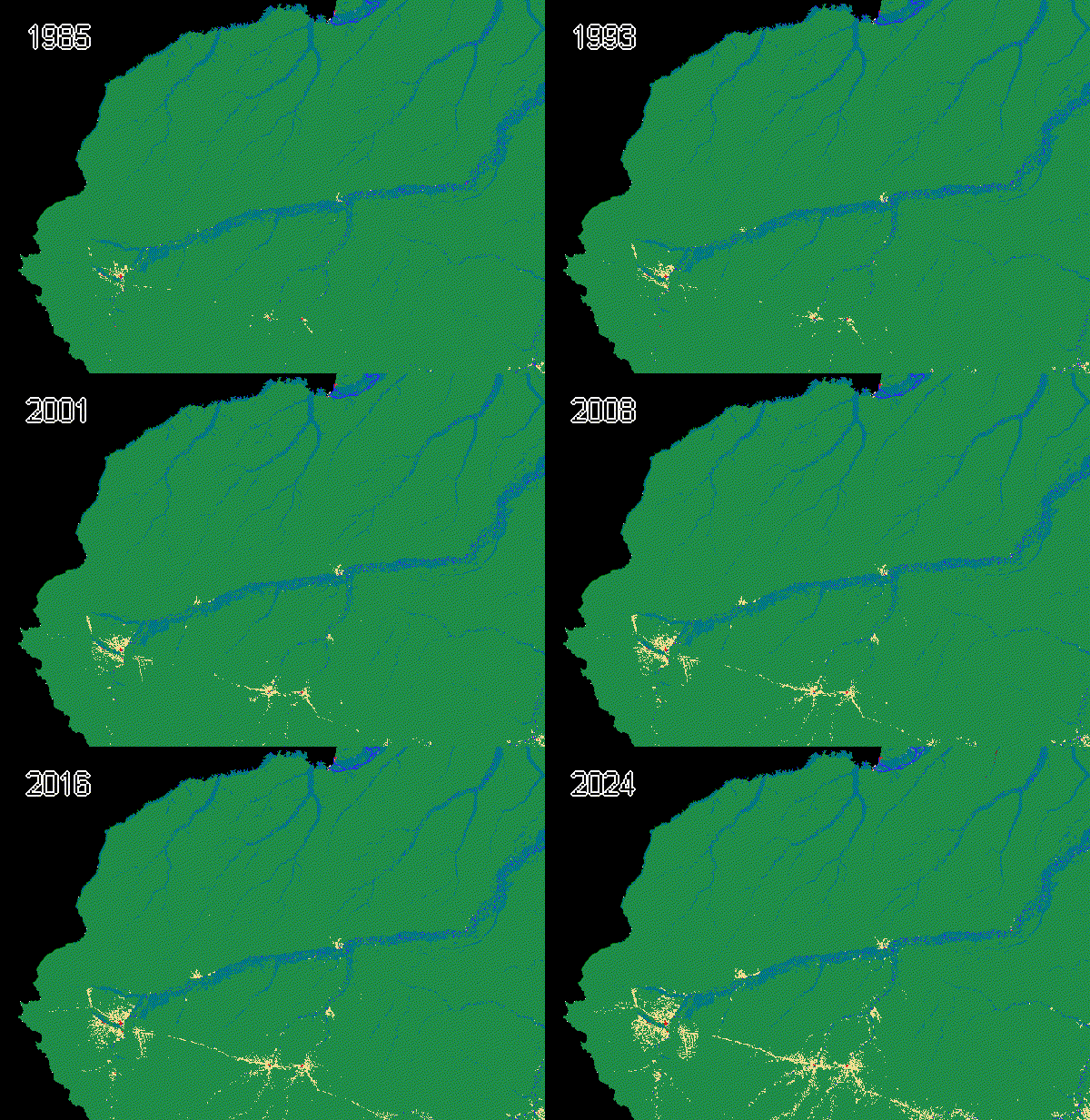
Trends in deforested area around the Vale do Javari Indigenous Territory, located north of the Juruá River. The loss of native vegetation has accelerated in recent years, especially in areas near the cities of Cruzeiro do Sul, in Acre, and Ipixuna, in Amazonas. (Source: MapBiomas)
“The CAR has been used as false proof of ownership of public lands surrounding the Javari Valley, which contains areas of Undesignated Public Forests. A large portion of these public areas is already occupied by irregular CARs and has suffered more from fires and deforestation in recent years due to this land grabbing. That is why the region needs swift action to cancel these registrations and constant enforcement to reduce the illegal use of this instrument,” explains Lívia Laureto, a researcher at IPAM and one of the study’s authors.
The study also points out that the area surrounding the indigenous land contains 4.8 million hectares of FPNDs (Undesignated Public Forests). These areas, which by law should be designated for a specific land-use category, remain without a legal definition, making them more susceptible to deforestation, land grabbing, and other illegal activities.
The researchers emphasize that, unlike conservation units, indigenous lands do not have legally recognized buffer zones. These areas, created to reduce the impacts of environmental degradation and land grabbing at the edges of conservation units, establish limits on economic activities and the degree of exploitation permitted in the vicinity of protected territories.
Indigenous Protection
The Javari Valley is home to five recently contacted indigenous peoples: the Marubo, Mayoruna, Matis, Kanamari, and Kulina. The territory is also inhabited by the Korubo and Tsohom-Djapá peoples, in addition to being home to at least 14 groups living in voluntary isolation—the largest concentration of such populations in the world.
Due to their geographic location, many communities depend exclusively on traditional hunting, fishing, and farming—activities directly linked to the ecological integrity of the territory. For isolated peoples, this dependence makes their survival even more vulnerable to climate change and invasions carried out by organized crime.
“When communities are threatened and suffer damage, their own efforts to protect their territories can be compromised, allowing for further invasions, the associated degradation of forests and watersheds, greater exposure to fires that can spread through the Amazon rainforest during droughts exacerbated by climate change and other negative dynamics. This spiral of destruction has also begun to spiral out of control in other indigenous territories,” the researchers write.
The authors also emphasize that the vast size and difficult access to the Javari Valley make it even more important to strengthen monitoring carried out by the indigenous peoples themselves, as well as firefighting brigades and community-building initiatives. In many cases, local residents are the only ones capable of quickly identifying fires, land invasions, and other threats, playing a fundamental role in protecting the territory and its inhabitants.
Land Designation and COP
According to the researchers, accelerating the demarcation of indigenous lands and the allocation of public forests is one of the key strategies for protecting indigenous peoples and curbing the degradation of the Amazon. This measure is also in line with the commitments made by Brazil during COP30 in Belém, when the government pledged to strengthen the territorial rights of indigenous peoples and make progress on the demarcation of new territories.
Despite this, the article warns that “monitoring efforts on indigenous lands are often nonexistent or lack sufficient resources.” Following the murders of Bruno Pereira and Dom Phillips, representatives from the Inter-American Commission on Human Rights traveled to the Javari Valley to assess the protection conditions for indigenous leaders and environmental defenders. The commission concluded that, despite the international attention the case received, little had changed in terms of protection in the region.
Cover photo: Bruno Kelly / Amazônia Real