
Suellen Nunes*
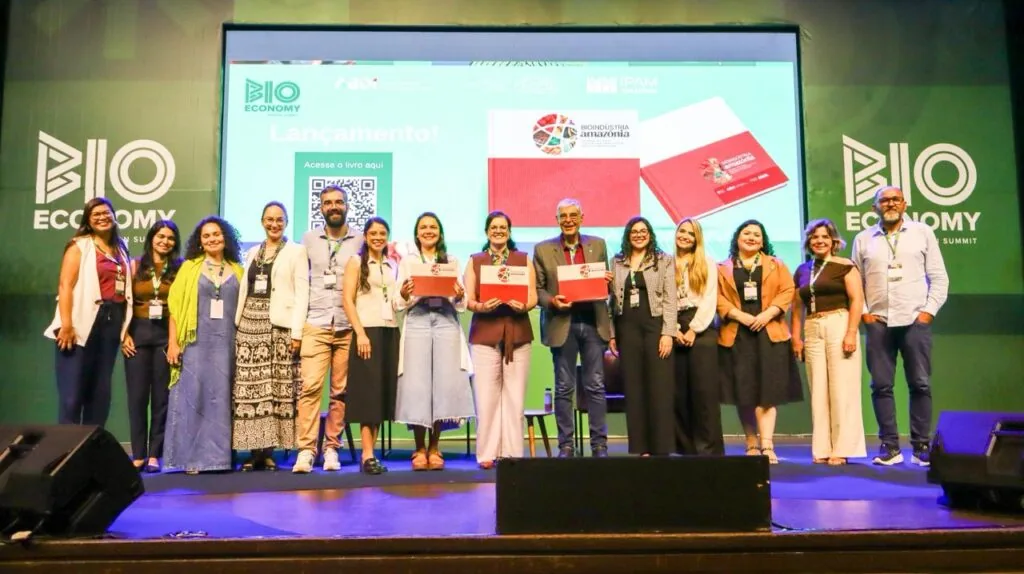
The launch of the book “Bioindústria na Amazônia: Contribuições para o desenvolvimento sustentável na Amazônia Legal” (Bioindustry in the Amazon: Contributions to sustainable development in the Legal Amazon), a publication developed in partnership between IPAM (Instituto de Pesquisa Ambiental da Amazônia) and ABDI (Agência Brasileira de Desenvolvimento Industrial), was part of the program for the 3rd edition of the Bioeconomy Amazon Summit 2026, held between May 12 and 15 in Belém (PA). The event dealt with the bioeconomy, innovation, territorial development and public policies aimed at the Amazon, bringing together representatives of the productive sector, governments, researchers and civil society organizations.
The publication was presented during a panel promoted by IPAM and ABDI, held on Tuesday afternoon (12), at the Maria Sylvia Nunes Theater, in Estação das Docas. The book highlights that the Amazon bioeconomy depends on valuing socio-biodiversity, strengthening sustainable production chains and expanding processing capacity and adding value in the Amazon territories themselves.
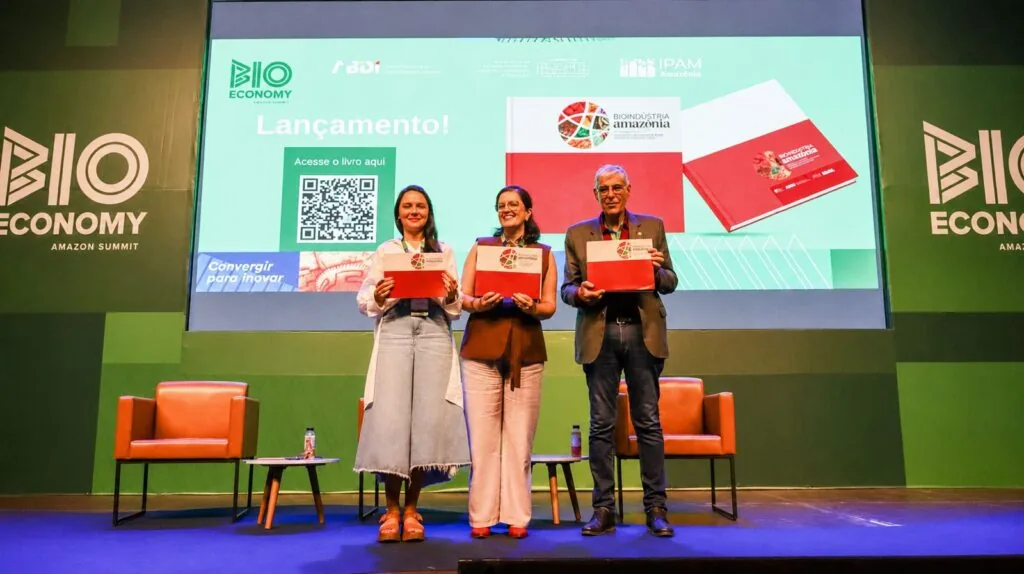
The study also points out that the bioindustry can act as a link between biodiversity, traditional knowledge, science and the market, promoting productive inclusion, generating local income and strengthening territorial economies. Among the challenges identified are logistical limitations, restricted access to funding, low local processing capacity and the need for public policies adapted to the different realities of the Legal Amazon.
“The data shows that the Amazon bioindustry already moves thousands of people and production chains throughout the region, with more than 11,000 formal enterprises mapped,” says Gabriela Savian, IPAM’s Public Policy Director. “In addition to the structural bottlenecks historically known in the Amazon, there is also a large information gap on socio-biodiversity enterprises. While we have identified more than 11,000 formal enterprises, there are thousands of other businesses operating informally in the Amazon territories. Often, public policies still operate according to a conventional logic, which doesn’t keep up with the dynamics and specificities of these new bioeconomy ventures and businesses,” she explains.
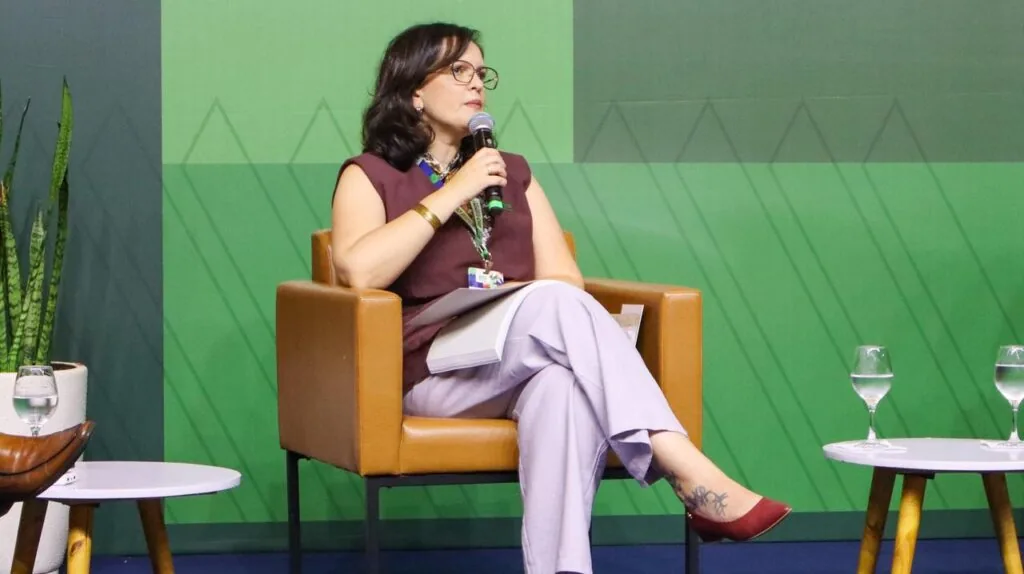
According to Savian, strengthening the bioindustry in the Legal Amazon involves expanding access to credit, regularizing land ownership and strengthening social organizations and socio-biodiversity production chains. “The Amazon requires solutions connected to the diversity of its territories. We can’t just work with ready-made, pasteurized business models,” he said.
ABDI works to support the formulation of strategies to increase innovation and the competitiveness of Brazilian industry, including initiatives linked to the bioeconomy. “This book is the result of work carried out over the last two years, bringing together data, research and surveys carried out in the nine states of the Legal Amazon. The publication shows the dimension of the Amazon bioindustry based on the mapping of enterprises and creates opportunities for new investments, strengthening production chains, product development and value generation in the Amazon territories,” said Ricardo Martins, ABDI representative.
For Ellen Acioli, an Amazon specialist from the IDB (Inter-American Development Bank) who took part in the launch, the study contributes to broadening the understanding of the organization of socio-biodiversity businesses in the Amazon and reinforces the strategic role of the bioeconomy on the global stage.
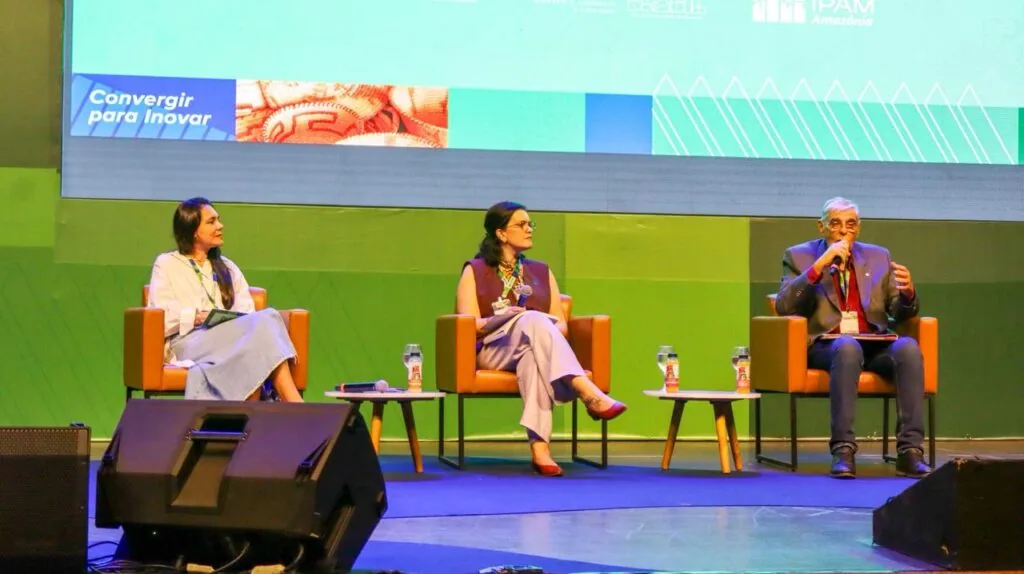
“From this research and data collection process, it was possible to open a kind of ‘Pandora’s box’ to understand how socio-biodiversity businesses are organized industrially in the Amazon. The bioeconomy is already a global agenda and, when we look at the Amazon, we understand that this debate takes on a strategic geopolitical dimension for the future. Thinking about this future also requires recognizing biodiversity as an economic potential and competitive advantage for the sustainable development of the region,” says Acioli.
Debates on public policies and territorial development
During the three-day BAS 2026 program, IPAM took part in debates on public policies, urban development, regenerative agriculture and strengthening the Amazon bioeconomy.
On Tuesday (12), the first day of the program, Gabriela Savian represented the Institute on the panel “Bioeconomy as a path to socioeconomic transformation in the Amazon through public policies”, at the Bioeconomy Park.
“We still have public policies and economic models that look at the bioeconomy from external standards, often without considering the diversity of the Amazon territories. The challenge is to balance income generation, the strengthening of production chains and economic development with the sustainability of natural resources, ways of life and the traditional practices of local communities. We need to build solutions that are connected to the reality of the Amazon,” concluded Savian.
On Wednesday (13), IPAM’s Public Policy researcher, Rafaela Reis, took part in the fireside chat “Bioeconomy in the City”. The debate addressed the relationship between the bioeconomy, urban development, infrastructure, innovation and the strategic role of Amazonian cities in building a new forest-based economy.
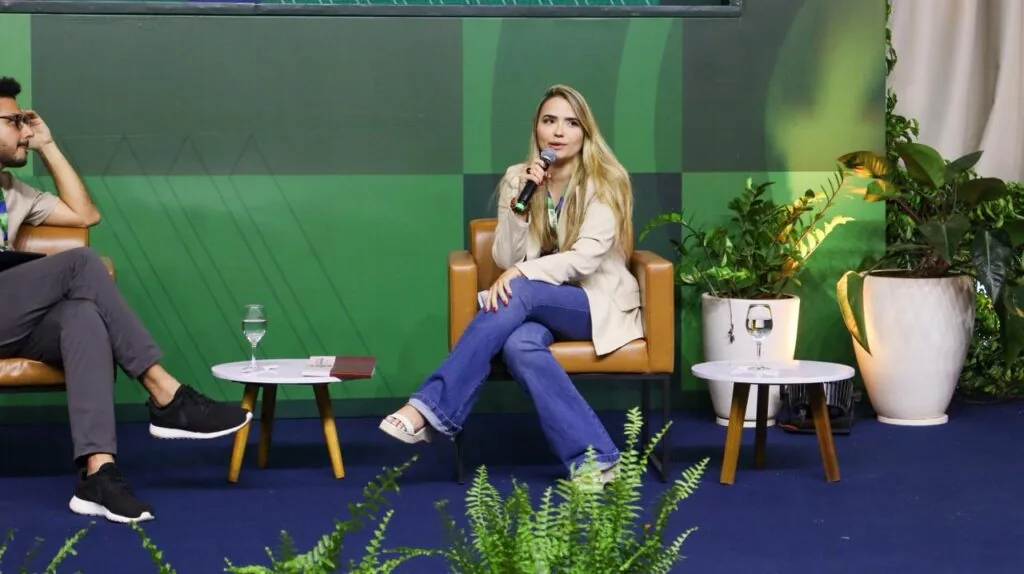
“We need to think about Amazonizing the bioindustry, and not just replicating foreign models in the Amazon. The study shows that the Amazonian bioindustry is deeply connected to the region’s territories, socio-biodiversity chains and urban dynamics. The bioeconomy and bioindustry also play a strategic role in connecting forest and city by generating jobs, strengthening local markets and stimulating a sustainable, long-term ecological and economic transition. Strengthening this agenda requires solutions adapted to the reality of the Amazon, from infrastructure and innovation to social organization, adding value and access to markets,” said Rafaela Reis, a researcher at IPAM.
On Thursday (14), Elisangela Trzeciak, IPAM’s researcher and regional coordinator for Transamazônica and Xingu, was on the panel “Training and Technical Assistance for regenerative agriculture at scale”, held at the Bioeconomy Park.
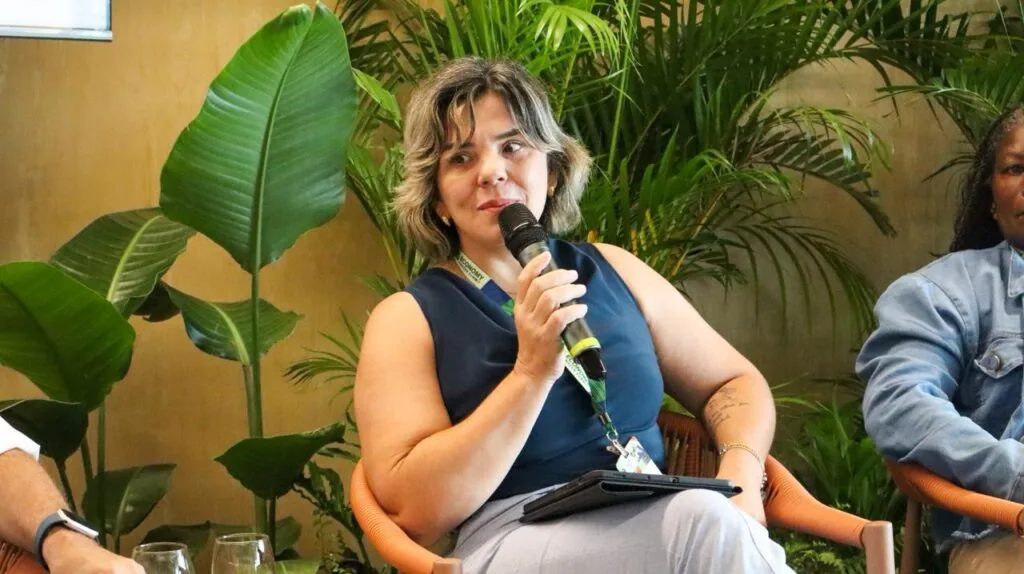
For the researcher, projects “on the ground” help generate lessons that can be transformed into public policies. “In the Transamazon and Xingu regions, IPAM operates in 9 municipalities, developing actions that combine forest restoration, organizational strengthening, income generation and territorial development. Sustenta e Inova is one of the projects carried out by IPAM in the territory, which argues that regeneration models need to take into account the specificities of each Amazonian territory and integrate production and conservation.”
Sustenta e Inova project creates links with the bioeconomy
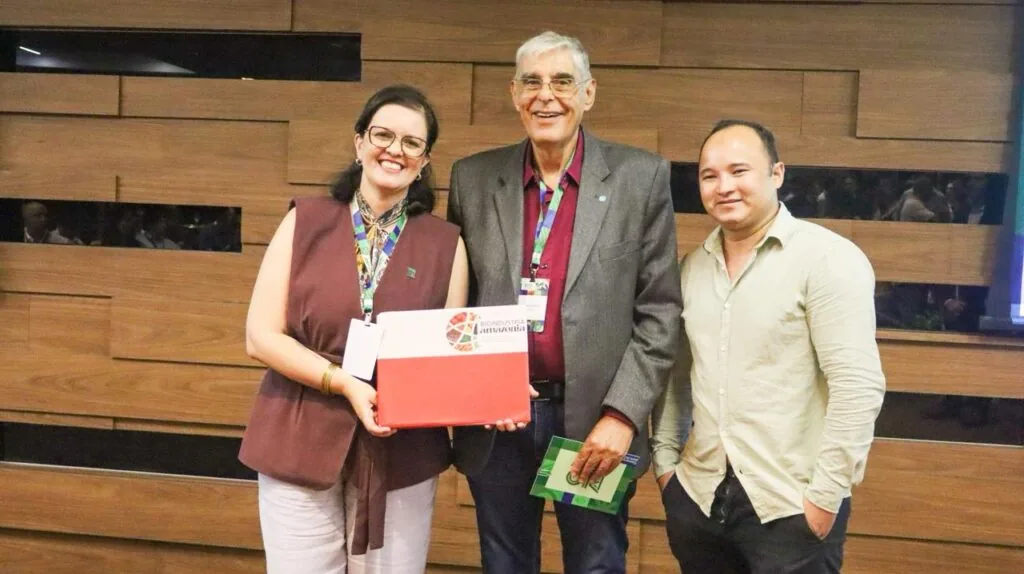
IPAM was present alongside beneficiaries of the Sustenta & Inova project, who presented products and experiences to the event’s participants. Funded by the European Union and coordinated by the Brazilian Micro and Small Business Support Service (SEBRAE), the initiative in the Transamazon region seeks to develop and implement sustainable and innovative agricultural practices, as well as promoting the strengthening of value chains in the Amazon. The Bioindustries Book was also highlighted at the launch during a cocktail party held at the headquarters of FIEPA (Federation of Industries of the State of Pará), during the first day of the program.
With technical assistance from the Institute, Sustenta & Inova serves 250 farming families, 18 family farming enterprises and supports municipal environmental and agricultural administrations in six municipalities in the Transamazon area. As well as working directly in the territory, the project also contributes to strategies to strengthen the bioeconomy in Pará by supporting the construction of public policies and a business environment focused on Amazonian socio-biodiversity.
As a strategy for scaling up the actions developed in the region, the program has been working with the political framework for the bioeconomy in the state since the beginning of the project. Among the contributions are support for the Pará State Bioeconomy Strategy, launched during the World Bioeconomy Forum in 2021, as well as participation in the construction of the State Bioeconomy Plan (PlanBio). The project also contributed to the initial conceptual development of the Bioeconomy Park, an initiative aimed at strengthening innovation, adding value and attracting sustainable investment to the Amazon.
A beneficiary of the program, the cocoa producer from Brasil Novo, Iradir Frutuoso, shares the growth trajectory of her work. “It’s been three years since we built the factory, with a lot of effort and dedication, always working with organic cocoa and seeking quality in every product. Our 50% chocolate with coffee is one of the products that most represents this care. Seeing our products gaining ground and recognition is a source of great pride, and the partnerships and support we have received have been fundamental in strengthening and continuing this work,” he concludes.
IPAM Communications Analyst*