
By Bibiana Alcântara Garrido*
The Brazilian government announced the demarcation of 14 indigenous lands, in different stages, at the start of the second week of COP30, the United Nations climate conference taking place in Belém. Ten territories were signed on Monday (17), Indigenous Peoples’ Day at COP30, and four more on Tuesday morning (18).
For IPAM (Amazon Environmental Research Institute), the demarcation is a step forward in guaranteeing the rights of indigenous peoples and demonstrates the Brazilian government’s commitment to the original peoples of Brazil during COP30.
“This is a long-awaited announcement and one that the indigenous movement is celebrating. This delivery doesn’t solve all the problems and demands of demarcation and guaranteeing rights, but it is a clear message of the government’s commitment to the indigenous demands brought up at the COP,” commented Paula Guarido, coordinator of IPAM’s Indigenous Studies Center.
On Tuesday (18), the Kaxuyana Tunayana (PA), Manoki (MT), Uirapuru (MT) and Estação Parecis (MT) lands were approved. On Monday (17), the Tupinambá de Olivença (BA), Vista Alegre (AM), Comexatiba – (Cahy-Pequi) (BA), Ypoi Triunfo (MS), Sawre Ba’pim (PA), Pankará da Serra do Arapuá (PE), Sambaqui (PR), Ka’aguy Hovy (SP), Pakurity (SP) and Ka’aguy Mirim (SP) territories were declared.
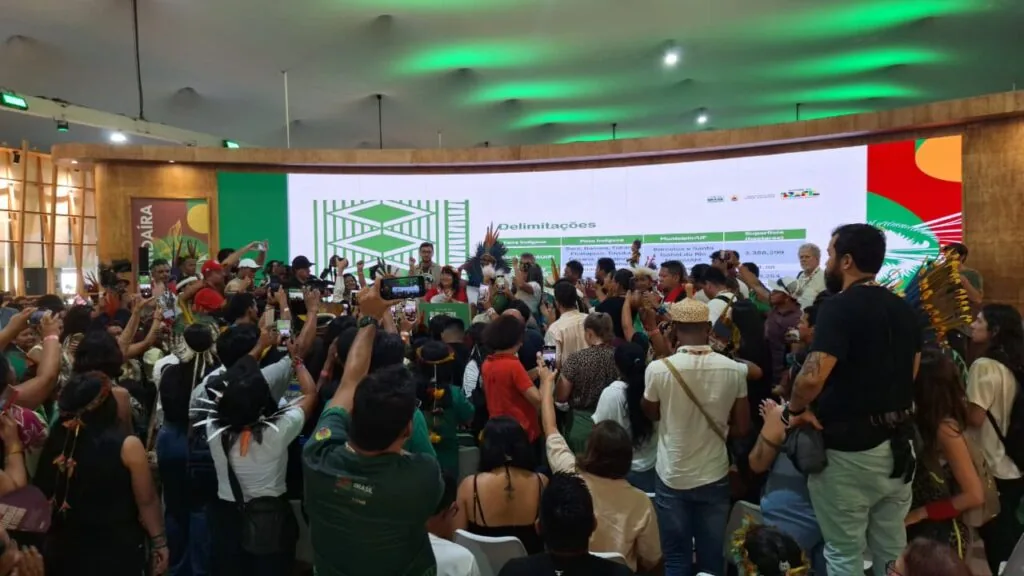
Brazil Pavilion full in the Green Zone, on Tuesday (18), at an event on the demarcation of indigenous lands
The demarcation of indigenous lands is made up of five stages: the first is identification and delimitation, carried out by FUNAI; the second is declaration; the third is physical demarcation; the fourth is homologation; and the fifth is the registration of the indigenous land with the Federal Property Office and the land registry office.
“It seems very little in relation to the liabilities we have in terms of territories to be signed in Brazil. But you know that we managed to make this progress even with so much pressure to the contrary, even in the face of an impediment like the temporal milestone law. You know it wasn’t easy, but we managed to win and we’re going to make even more progress on demarcated territories,” said Sônia Guajajara, Minister of Indigenous Peoples, at an event in the COP30 Green Zone on Tuesday morning (18).
Joênia Wapichana, president of FUNAI (National Foundation for Indigenous Peoples), also celebrated the demarcation of lands. “Our work has to fulfill the constitutional mission of demarcating and protecting indigenous lands and peoples. It is in this indigenous administration that we are making progress in land regularization. Lands that have been long awaited, lands that people are celebrating today,” he said.
The authorities also signed the delimitation of the territories at the Green Zone event on Tuesday (18): Aracá-Padauiri (AM), Curriã (AM), Kulina do Rio Ueré (AM), Gaviãozinho (AM), Riozinho Iaco (AC) and Pindó Poty (RS).
The creation of working groups to identify and delimit the Nadëb (AM), Maraguá-Mawé (AM), Tuyuka (AM), Rio Paracuní e Curupira (AM), Deni do Rio Cuniuá (AM), Chandless (AM) and Kanamarí do Jutaí (AM) indigenous lands was also signed.
The following indigenous reserves were also created: Kanela do Araguaia (MT), Crim Patehi (TO), Laklãnõ Xokleng (SC), Valparaíso (AM), Uty-Xunaty (RO), Guajanaíra (PA), Juruna do KM 17 (PA), Jenipapeiro (BA), Maturêba (BA) and Nazário e Mambira (CE).
According to IPAM, indigenous lands function as the “air conditioning of Brazil”: an analysis showed that the Xingu Indigenous Territory, for example, is 5°C cooler than its deforested surroundings, occupied by monoculture and pastures.
In the Amazon, indigenous lands hold 30% of the biome’s native vegetation. Even though they are the least devastated areas in the country, the territories that have not yet been demarcated suffer more from deforestation than those that have already been officially recognized.
According to the study “Demarcation is Mitigation”, published during COP29 by IPAM in partnership with Apib (Articulation of Indigenous Peoples of Brazil) and CIMC (Indigenous Committee on Climate Change), undemarcated territories have 0.2% of their area deforested per year, while demarcated ones have 0.05%.
The IPAM expert points out that the main threats to indigenous lands in Brazil are deforestation and land grabbing. In the Amazon, territories with isolated peoples are most at risk. Uncontrolled fire is also a cause for concern: in the Cerrado, 67% of indigenous lands saw an increase in the area burned in 2024.
*IPAM journalist, bibiana.garrido@ipam.org.br