
Translation of an interview originally published by China News Service
Title: Why does China’s “two mountains” concept resonate with the world?
Interviewee: André Loubet Guimarães, executive director of IPAM (Amazon Environmental Research Institute)
Author: Qian Chenfei
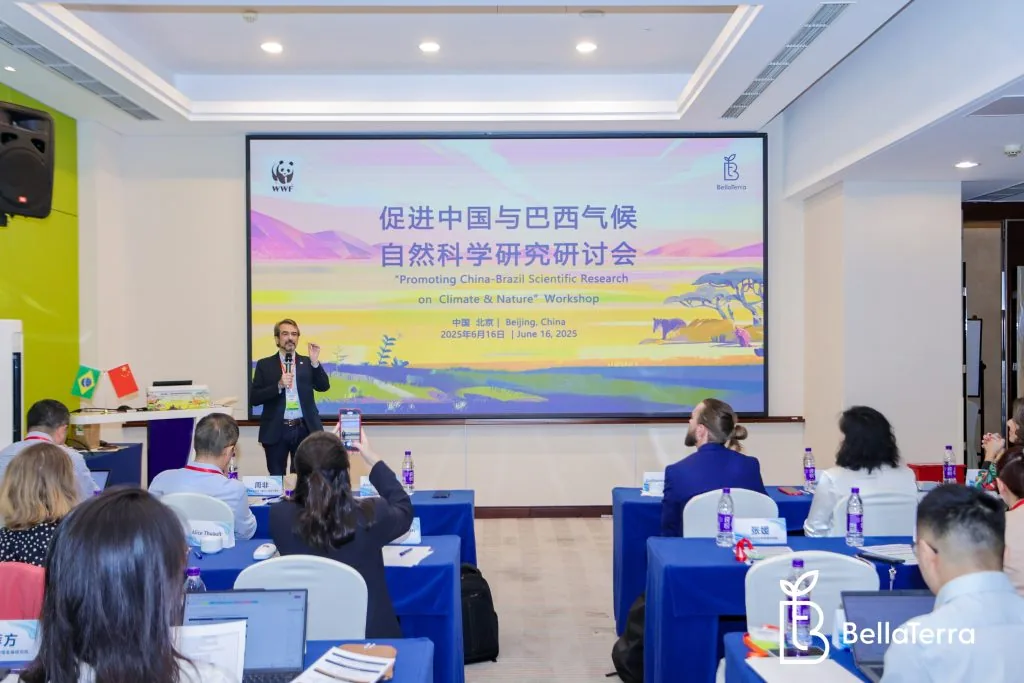
André Guimarães, executive director of IPAM, speaks during an event in Beijing
China News Service, Hangzhou, October 24 – 2025 marks the 20th anniversary of the concept of “clean water and green mountains are mountains of gold and silver”. After 20 years of enrichment and development, this concept has not only gathered consensus in Chinese society, but has also been widely recognized by the international community.
The concept of “clean water and green mountains are mountains of gold and silver” profoundly explains the relationship between economic development and ecological environmental protection. How does this practical achievement in Zhejiang, China, echo the concept of global sustainable development? How can the concept of community with a shared future for humanity be made ever more distinct in the practice of protecting our common home? Recently, André Loubet Guimarães, executive director of the Amazon Environmental Research Institute, was interviewed by China News Service’s “East and West Questions” program and expressed his views.
The transcript of the interview is summarized as follows:
China News Service: How do you understand that “clean waters and green mountains are mountains of gold and silver”?
André Loubet Guimarães: When it comes to “clean waters and green mountains are mountains of gold and silver”, I can’t help but think of my trip to China in June this year. I had the privilege of working with colleagues from IPAM and representatives from other Brazilian civil society organizations to interact with Chinese ecological and environmental researchers. During the trip, we not only heard about this concept many times, but also witnessed its implementation in the daily work of Chinese institutions.
In my opinion, the concept of “clean waters and green mountains are mountains of gold and silver” expresses the essence of nature conservation as a strategic means to achieve long-term health and prosperity for people around the world. Today, we can no longer prosper if nature is neglected.
People need clean waters and green mountains, clear rivers and clean air, and only in this way can the sustainable development of the country be achieved, simultaneously promoting economic and social progress. Only by seeing ourselves as part of nature, rather than separate from nature, can we guarantee food security and well-being for all – this is the central message of the concept of “clean waters and green mountains are mountains of gold and silver” as I understand it.
China News Service: How do you understand the “philosophy of balance” contained in this concept? What does this Eastern wisdom have in common with the concept of global sustainable development?
André Loubet Guimarães: Economic growth and nature conservation have long been seen as opposing options, and development processes around the world often occur at the expense of the environment and natural resources. And the “philosophy of balance” allows us to realize that we have moved beyond this stage.
In recent years, more and more leaders have realized that protecting the environment is actually about protecting the economy and society. It can be seen that the Eastern wisdom embodied in the concept of “lucid waters and green mountains are mountains of gold and silver” is highly compatible with the concept of sustainable development, providing ideas and practices for global green transformation to benefit present and future generations.
As Chinese President Xi Jinping pointed out: “We should not sacrifice the ecological environment in exchange for temporary economic development” and “biodiversity makes the earth full of vitality and is the basis of human survival and development”.
China News Service: What do you think are the main aspects of the current global ecological problems? What kind of reference can the practical experience of the concept of “clean waters and green mountains are mountains of gold and silver” provide for the world?
André Loubet Guimarães: “Balancing ecological protection and economic development” is a common global issue. If there is a global consensus on China’s concept of “lucid waters and green mountains are mountains of gold and silver”, we can develop a more comprehensive action plan to address ecological issues such as climate. While considering technology and innovation as essential assets, we should also consider ecological restoration and protection as an insurance policy to guarantee humanity’s common future.
The main reason for the persistence of global ecological problems is the gap between words and actions. Hundreds of researchers participating in the Intergovernmental Panel on Climate Change agreed that we have all the technology and information needed to mitigate climate change and comply with the Paris Agreement to achieve the goal of limiting the global temperature increase to 1.5°C above pre-industrial levels, but what is currently lacking is action.
Effective public policy requires putting into practice what we already know. China’s ability to plan and implement the necessary changes provides an example for the world to tackle environmental challenges.
China News Service: What are the opportunities for ecological protection in the Global South? How can we work together to make greater contributions to global environmental governance?
André Loubet Guimarães: China has been Brazil’s main trading partner for the past 15 years. During our visits to Beijing, Shanghai and Hangzhou in June, we discussed with Chinese experts how to improve this trade relationship from an ecological perspective, with the aim of bringing economic and social benefits to both countries.
Based on this, from the scientific point of view of the Amazon Environmental Research Institute, Brazil and China have great potential for cooperation in the field of research cooperation for sustainable development and green trade. Research cooperation can facilitate the sharing of knowledge and the exchange of technology and will help the countries of the Global South to cooperate in the construction of ecological civilization, driven by broader initiatives.
In November this year, the 30th Conference of the Parties (COP30) to the United Nations Framework Convention on Climate Change (UNFCCC) will be held in Belém, Brazil. This is an unmissable opportunity, which will bring together advanced scientific achievements from various countries to lay a solid foundation for global ecological protection after COP30: let’s work together and pull together to provide the world with the answers everyone needs.
Cover photo: On August 11, 2025, in Yucun, Huzhou, Zhejiang, a stone monument engraved with the words “Clean water and green mountains are mountains of gold and silver” (Sun Yangyang)