Karina Custódio*
Indigenous peoples and their territories are central to combating climate change. This is the main message of the booklet “Indigenous Peoples facing climate change”, launched on Wednesday (27). The material can be accessed online and will be delivered throughout the year to civil servants directly involved in working with indigenous peoples. The production is a partnership between IPAM (Instituto de Pesquisa Ambiental da Amazônia), IPÊ (Instituto de Pesquisas Ecológicas) and Funai (Fundação Nacional dos Povos Indígenas), with support from Hivos, the Amazon Fund and the Moore Foundation.
“IPAM values disseminating quality information to support decision-making. This publication follows this line, seeking to provide information for employees of FUNAI and other related bodies, as well as indigenous leaders,” explains Martha Fellows, a researcher at IPAM.
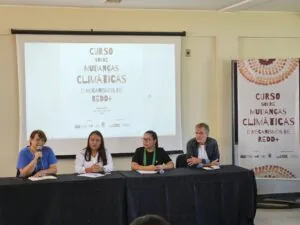
The booklet was first conceived as didactic material to complement the training process for FUNAI employees working in indigenous territories in the Brazilian Amazon, which took place last year.
“The booklet was put together by several hands and has important technical content. It was designed to support FUNAI employees, so that they have information when guiding or building regulations on the subject,” says Neluce Soares, executive coordinator of the LIRA/IPÊ (Legado Integrado da Região Amazônica) initiative.
Although designed to guide civil servants, the publication can be used to raise awareness among all audiences, as it has accessible language. Its content ranges from basic concepts, such as what climate change is, to a contextualization of climate negotiations.
“The publication will also be used to train members of the climate justice network of the Voices for Fair Climate Action (VAC) program, which brings together indigenous peoples, traditional and peripheral communities from all over Brazil. The network has its members articulated by the Indigenous Peoples and Climate Justice coalition and led by COIAB [Coordination of Indigenous Organizations of the Brazilian Amazon],” says Paula Moreira, national manager of Hivos.
Instruction on REDD+
One of the main points of the newsletter is REDD+ (Reducing Emissions from Deforestation and Forest Degradation and Conservation), a mechanism created to help finance conservation.
“Dealing with the challenges of implementing the REDD+ mechanism, whether in private projects or jurisdictional programs, is a very big and concrete demand at FUNAI. The booklet is support material that we hope will help level the understanding of the mechanism,” says Luana Almeida, coordinator of Funai’s Copam (Environmental Policy Coordination).
According to the coordinator, many indigenous peoples request that the agency explain and monitor the implementation of carbon credit trading projects through CLPI (Free, Prior and Informed Consultations), a process necessary to implement the mechanism on indigenous lands, as established by ILO (International Labor Organization) Convention 169.
Communications analyst: karina.sousa@ipam.org.br*