By Mayara Subtil*
IPAM (Amazon Environmental Research Institute) and CAU (China Agricultural University) signed on Tuesday (the 15th), in Beijing, China, a MOU (Memorandum of Understanding) to conduct joint research and expand dialogue on sustainable food systems. The partnership covers topics such as food security, climate change, deforestation and land use, smart and resilient agriculture, and green trade.
The agreement was signed by André Guimarães, executive director of IPAM and special envoy for civil society at COP30, and Shenggen Fan, professor at CAU and dean of AGFEP (Academy of Global Food Economics and Policy), a university-level research institute supported by CAU.
One of the cornerstones of this cooperation will be GALO (Global Assessment from Local Observations), a project developed by IPAM and the Woodwell Climate Research Center to investigate the relationship between agriculture and the conservation of native vegetation in the Amazon and the Cerrado. The initiative seeks to understand how climate and ecosystem conservation influence the stability of agricultural production and what approaches can make the sector more resilient in the face of the extreme effects of climate change.
“To continue feeding a growing population in the context of climate change, it is imperative that we understand that forests and food production are inseparable. This scientific collaboration specifically seeks even more evidence on the benefits of the ecosystem services provided by native vegetation for a stable climate and regular rainfall, which are so fundamental to food systems,” Guimarães emphasized.
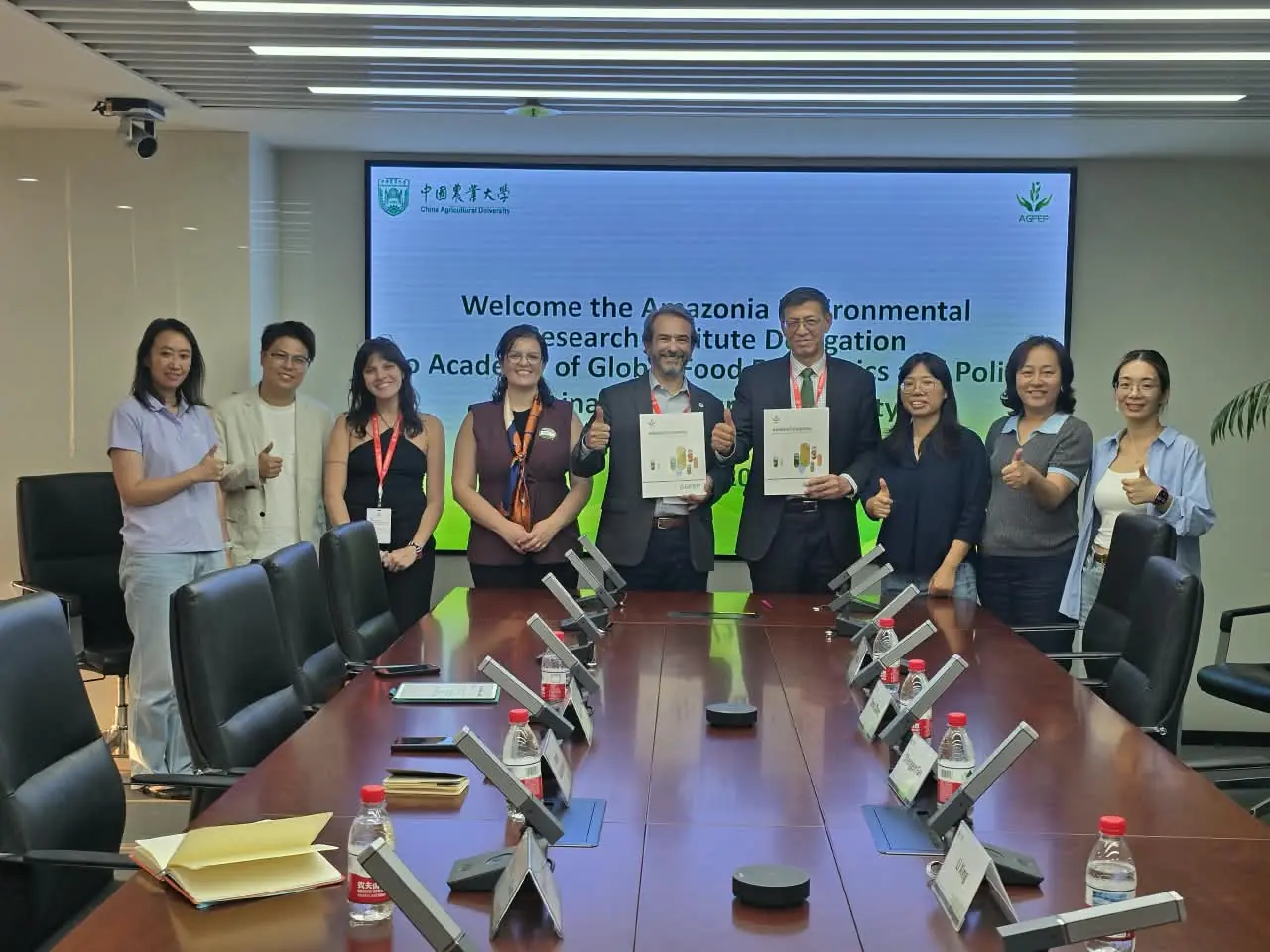
IPAM and CAU sign a partnership to develop research on sustainable agriculture. Photo: IPAM Archives.
“We are very excited to sign this agreement with IPAM. Brazil and China have much to share and learn from each other in the areas of food, agriculture, and the environment. We are truly eager to work with IPAM on research and evidence-based initiatives to ensure that Brazil and China can contribute—both to their own countries and to the world—to a more reliable, sustainable, and resilient food supply,” said Shenggen Fan.
Launched in 2023 during COP28 in Dubai, GALO combines data on climate, water availability and quality, carbon stocks, and biodiversity obtained through remote sensing and field observations. The research also includes an economic analysis of the ecosystem services provided by nature to agriculture and the effects of decisions to open up new areas on the viability of production in the medium and long term.
The goal is to identify agricultural models and land- and water-use strategies capable of contributing to climate stability in the region comprising the Amazon and the Cerrado. Among the objectives is to understand which landscape configurations can promote water availability, carbon storage, climate regulation, and biodiversity protection, while simultaneously supporting agricultural production.
The project also seeks to quantify the benefits and costs of transitioning from conventional agriculture to regenerative practices, which prioritize, among other aspects, the restoration and maintenance of soil health. The initiative is expected to last five years and received an initial investment of R$ 9.9 million from the German multinational Bayer.
Climate Risk in Rural Areas
One of the areas GALO is focusing on is calculating climate risk for rural properties in the Amazon and the Cerrado. The methodology makes it possible to assess how much a property’s productivity has been affected in the past by adverse weather conditions, such as periods of drought, and to project how this risk might unfold in the future.
The analysis cross-references productivity data with climate data to identify the main factors that hinder production and which management practices can mitigate these effects. Farmers also receive productivity projections based on IPCC (Intergovernmental Panel on Climate Change) climate models, allowing them to incorporate climate risk into their planning for upcoming harvests.
More than 70 farmers in Mato Grosso and Matopiba—a region comprising agricultural areas in Maranhão, Tocantins, Piauí, and Bahia—have already received analyses of their farms produced by the project. The goal is to transform the effects of climate change on agriculture into concrete information that can guide on-farm decisions and the adoption of more sustainable and resilient practices.
GALO’s findings already highlight the link between conservation and agricultural productivity. Research indicates that restoring native vegetation can increase productivity and reduce the risk of crop losses. In the case of soybeans, locally restored areas can contribute to an increase of up to ten bags—or 600 kilograms—per hectare.
The research is based on the understanding that native vegetation performs important functions for agricultural activity itself, contributing to climate regulation, water availability, carbon storage, and the maintenance of biodiversity. With the advance of climate change and the increased occurrence of extreme weather events, understanding this relationship becomes increasingly important for food security and the sustainability of agricultural production.
Brazil-China Cooperation
The partnership with CAU expands scientific cooperation between Brazil and China in a sector that is strategic for both countries. It is expected that the exchange between researchers will contribute to the generation of knowledge and the development of solutions related to food security, sustainable land use, and the adaptation of agriculture to climate change.
The signing took place as part of IPAM’s agenda in China, which brings together universities, research centers, and civil society organizations to strengthen cooperation between the two countries. On Monday (the 14th), the Institute participated in Beijing in the China-Brazil CSOs Closed-door Dialogue on Environmental Conservation, a meeting that discussed research priorities, opportunities for collaboration, and ways to expand the joint environmental agenda between Brazil and China between COP 30 and COP 33.
*Communications Analyst. mayara.barbosa@ipam.org.br