
By Mayara Subtil*
For more than three decades, Almir Narayamoga Suruí has sought to answer a question: how can we protect the forest without sacrificing the development of the communities that live there? For the indigenous leader, the answer lies in transforming environmental conservation into an economic opportunity, strengthening the Amazon and helping to tackle the climate crisis. The path has included reforestation initiatives, carbon projects, sustainable coffee production, and, more recently, the establishment of the first chocolate biofactory on indigenous land in the Amazon.
A native of the Sete de Setembro Indigenous Territory (TI), located between the states of Rondônia and Mato Grosso, Almir began his leadership journey in a context marked by the advance of illegal logging. It was in response to these challenges that he began developing strategies focused on forest conservation and the promotion of sustainable alternatives for his community.
Inhabited by the Paiter Suruí people, the Sete de Setembro Indigenous Territory spans just over 248,000 hectares and is situated in a region historically under pressure from the advance of non-indigenous occupation. Over the decades, logging, agricultural expansion, and road construction have transformed the surrounding landscape and come to pose ever-greater threats to the area.
Almir’s work in defense of indigenous peoples and the Amazon rainforest has extended beyond the boundaries of the Indigenous Territory. His work has been recognized by national and international organizations, including the UN, which honored him in 2013 with the title of “Hero of the Forest” for his role in the conservation of the Amazon. More recently, he has also been recognized for initiatives aimed at addressing the climate crisis and strengthening sustainable development models on indigenous lands.
“My life’s mission is to respect the forest. To use the forest as the best tool for the world’s balance. That is why the main projects we develop here are linked to the environment,” said Almir.
In the 1990s, more than 500 trucks left the indigenous territory loaded with timber every day, according to him. Faced with this situation, the Paiter Suruí people began developing a long-term strategic plan aimed at protecting their territory and, at the same time, creating sustainable economic alternatives.
Surveys conducted in the early 2000s indicated that part of the forest cover in Sete de Setembro had already been degraded and that some native species were disappearing from areas affected by logging. With this assessment, indigenous leaders, researchers, and partner organizations began to develop a 50-year territorial management plan.
The document, developed with the participation of Indigenous people and researchers, began to guide actions in territorial governance, environmental conservation, and community development, reconciling traditional knowledge and science.
One of the first initiatives resulting from this planning was the Pamine project, which in the Suruí people’s Tupi-Mondé language means “the rebirth of the forest.” Created in 2005, the project was launched with the goal of restoring areas degraded by logging and agricultural activities, as well as reintroducing native species essential to the community’s subsistence.
“We decided to restore the deforested areas and give back to the forest what had been taken from it. We needed to rebuild what was being lost,” Almir summarized.
The work began to be carried out through community work parties and involved different generations of the Suruí. Since then, more than one million seedlings have been planted, contributing to the recovery of degraded areas and the strengthening of local production chains.
Two years later, Almir began discussing the implementation of a payment mechanism for environmental services. The process resulted in the creation of Brazil’s first indigenous carbon project, completed between 2010 and 2011. The initiative enabled the sale of carbon credits generated by forest conservation and paved the way for new income-generating strategies linked to environmental protection.
Over the years, the community also began investing in production chains linked to socio-biodiversity. Coffee, Brazil nuts, and cocoa were integrated into a strategy aimed at adding value to forest products, combining production, conservation, and the economic empowerment of indigenous families.
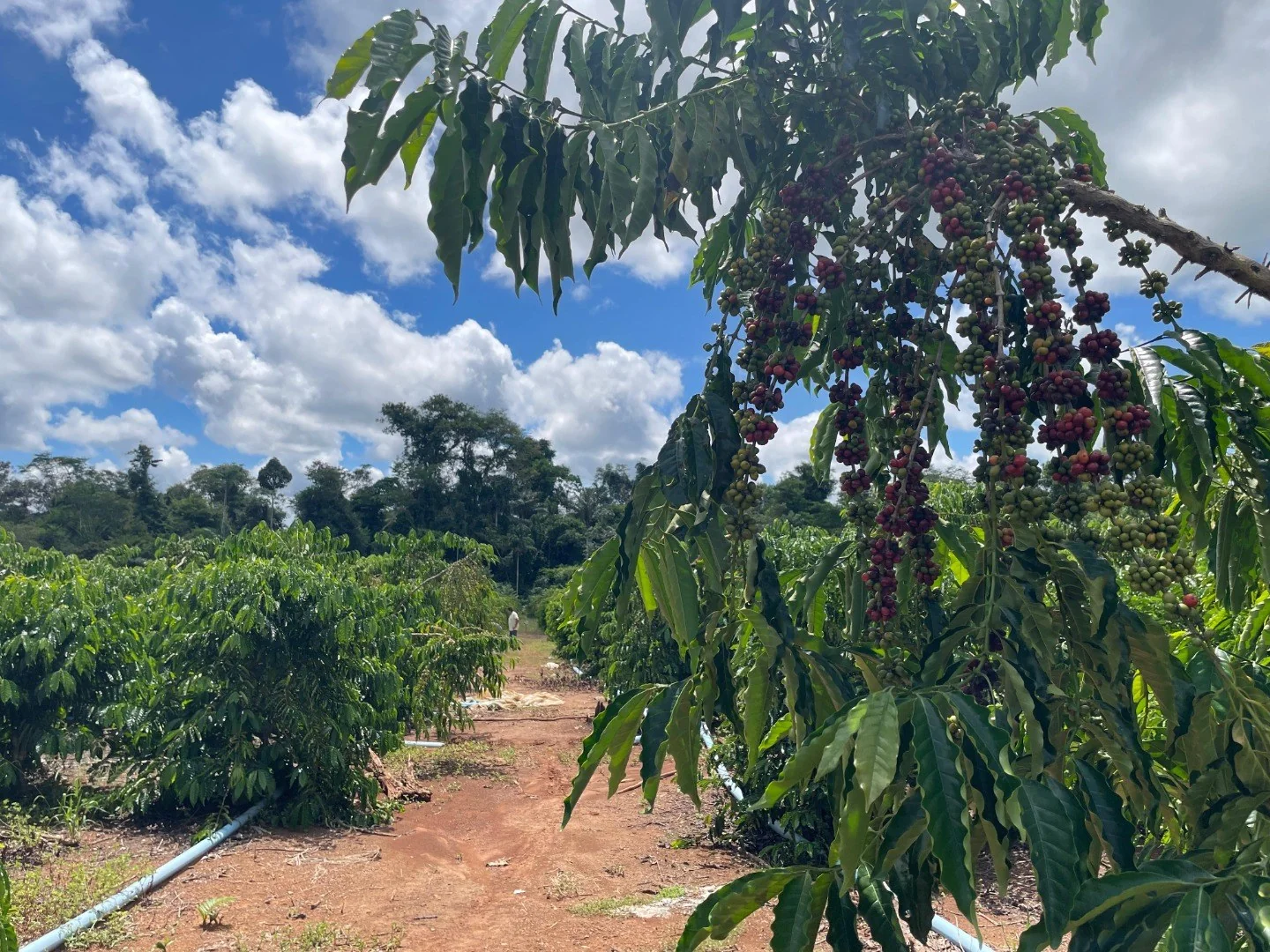
Coffee production in the Sete de Setembro Indigenous Territory. Photo: Lucas Vieira/Funai
Part of this journey is linked to the region’s own history of settlement. Over time, areas previously used for productive activities were incorporated into more sustainable management models, allowing products like coffee to gain ground as an economic alternative aligned with environmental conservation.
According to Almir, starting in 2017, the community began to intensify this process, seeking to transform its production into specialty products and expand its presence in niche markets. “We are increasingly focused on improving the quality of our production. It’s not about quantity. It’s about quality. We want to show consumers that what we produce has not only economic value but also reflects our responsibility toward people and the land,” he explained.
Coffee production has gained recognition beyond the region. In 2021, indigenous producers from Rondônia were recognized for producing some of the best Amazonian Robusta coffees in the state through the Tribos Project, an initiative aimed at strengthening sustainable coffee farming on indigenous lands.
First chocolate biofactory on indigenous land
The new chocolate biofactory emerges precisely within this context. Developed in partnership with the Amazon 4.0 Institute, the initiative aims to transform the cocoa produced in the territory into chocolate made by the indigenous people themselves, combining indigenous knowledge and processing technologies. The idea was presented to the community by climatologist Carlos Nobre and began to take shape about two years ago. Since then, indigenous people have been participating in training focused on cocoa processing through a laboratory set up on indigenous land.
Now, the final structure of the biofactory is under construction. The facilities are expected to be ready in August 2026, allowing for a new phase of training for the professionals who will work directly in production.
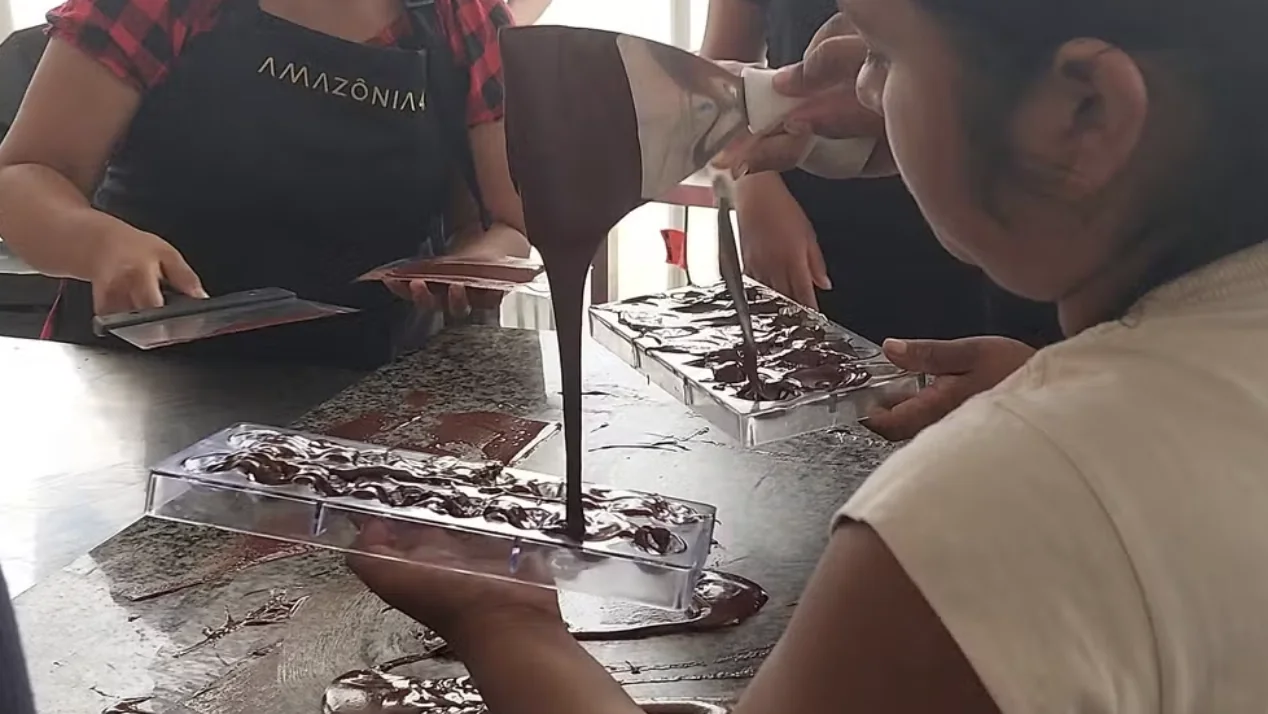
Suruí Indigenous people in a chocolate-making laboratory. Photo: Reproduction/Instituto Amazônia 4.0
In addition to adding value to locally produced raw materials, the project aims to create jobs within the community itself. The expectation is that workers involved in the production process will be paid and that the initiative will strengthen the local economy without increasing pressure on the forest.
“The goal is to produce a unique chocolate here, made on indigenous land, using indigenous labor, and organized through a combination of two types of knowledge: non-indigenous technology and indigenous technology. You won’t find chocolate like this anywhere else in the world,” Almir emphasized.
The project is intended to serve indigenous producers in the territory, but also aims to purchase part of the production from non-indigenous farmers in the surrounding area, provided that the crops meet socio-environmental criteria. For the indigenous leader, initiatives like this demonstrate that it is possible to build economic models compatible with environmental conservation. According to him, socio-biodiversity products can generate financial returns without reproducing the impacts associated with the advance of deforestation and illegal activities.
“Our struggle is to show that it is possible to economically develop a territory by producing in a planned manner, with environmental responsibility, and by combating climate change. The value of the product lies not only in what it produces, but also in how it is produced,” he said.
Despite the progress, Almir believes that significant challenges remain in scaling up this type of initiative. Among them is the difficulty in accessing resources and investments for sustainable projects on indigenous lands.
“It is very difficult to find investment for projects of this scale. There is no structured public policy to support this type of initiative within indigenous lands. And without that support, it becomes much harder to protect the forest and create opportunities for communities,” he added.
In the indigenous leader’s view, the lack of economic opportunities can encourage the spread of illegal activities, such as gold mining, logging, and irregular land leasing. For this reason, he advocates that initiatives aimed at generating sustainable income be strengthened through public policies and long-term investments. When speaking about the future, Almir emphasizes that protecting the forest does not mean preventing its use, but ensuring that it occurs in a planned and responsible manner.
“When we talk about protecting the forest, we’re not saying it’s untouchable. We’re saying it needs to be used with planning, responsibility, and with the future in mind. If the Earth stops producing because of our own actions, it won’t matter if someone is rich or poor. Everyone will be affected,” he concluded.
*IPAM Communications Analyst. mayara.barbosa@ipam.org.br