
By Bibiana Alcântara Garrido*
On Thursday (4), the Chamber of Deputies’ Commission on the Amazon and Original and Traditional Peoples held a public hearing to debate undesignated public forests. These forests occupy 50.2 million hectares of the Brazilian Amazon – an area the size of Bahia – and have yet to be set aside by the government, either as a conservation unit or indigenous land, for example.
IPAM (Amazonia Environmental Research Institute) and the Amazônia de Pé movement, responsible for the Observatory of Public Forests, presented data and information about these forests and their peoples.
According to data from the Observatory, 62.3% of the unallocated public forests in the Brazilian Amazon are state land, while 37.6% are federal. Also according to the platform’s data, around 13 million hectares of these forests are currently in the process of being set aside by the federal government.
“IPAM has been working for many years on analyzing public forests that have not been set aside together with their peoples, providing input for public policies in a collective construction. This is because in the Amazon there is an area of forest the size of Bahia that is in danger of disappearing. What we are seeing from these studies is an increase in illegal activities, mainly with evidence of land grabbing through the fraudulent use of the CAR [Rural Environmental Registry]. Without protection, we run the risk of losing them for good,” said Rebecca Lima, a researcher at IPAM and coordinator of the Observatory of Public Forests, in a presentation during the meeting.
“The slowness of the allocation process increases land concentration, intensifies social conflicts, compromises the security of traditional peoples and communities and affects everyone, since the flying rivers of the Amazon carry water for the country,” she added. The public hearing was chaired by Congressman Reginaldo Veras (PV-DF) and was in response to a request by Congresswoman Célia Xakriabá (Psol-MG).
Land grabbing of public forests
According to the Observatory of Public Forests, there are currently 32.7 million hectares of these forests under illegal registration in the CAR (Rural Environmental Registry). The area with overlapping CARs has increased since 2019, especially with registrations larger than 15 fiscal modules.
If undesignated public forests remain unprotected, deforestation in these areas could release up to 19.1 billion tons of CO2 into the atmosphere. This is equivalent to 51% of global emissions estimated for 2024.
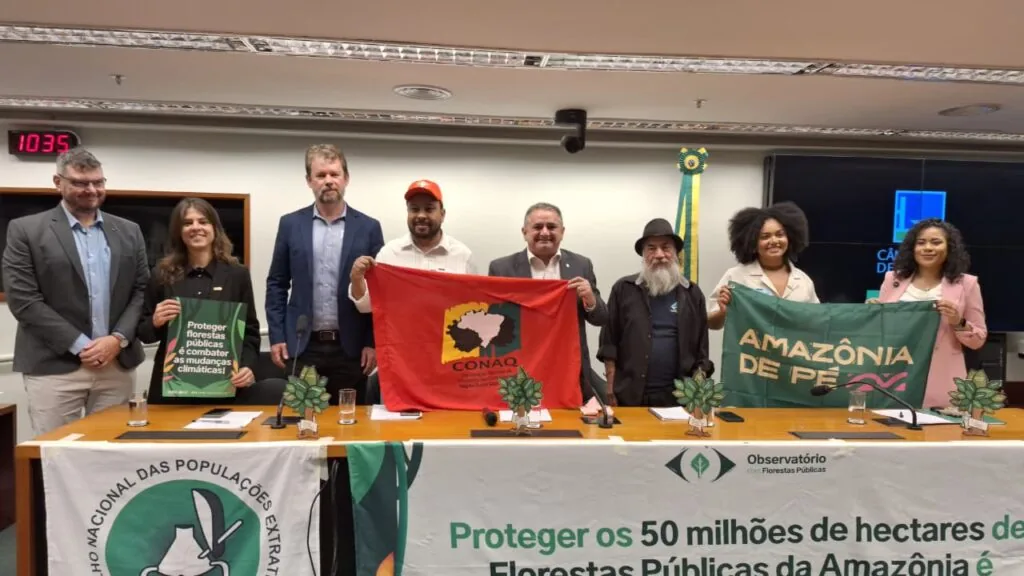
IPAM presented data from the Observatory of Public Forests showing evidence of land grabbing in the Amazon (Photo: Bibiana Garrido/IPAM)
“The allocation of public forests is one of the most important climate action strategies for meeting national and international climate targets and for protecting forests and their populations. And this allocation must be accompanied by public policies, strengthening the development of a sustainable economy in the Amazon. The allocation is urgent, a commitment made by law, in defense of Brazil, the Amazonian peoples and future generations,” Lima concluded.
In 2025, more than 62,000 hectares of undesignated public forests were already deforested, according to data from the Observatory. The state of Amazonas accounted for the majority (62%) of this deforested area.
From January to July 2025, more than 59,700 hectares were burned in undesignated public forests. Most of the fires (75%) took place on federal land and in the state of Pará.
Mobilizing for the Amazon
“More and more people understand that what happens in the Amazon is not just about the Amazon. We present data, but it also involves people. We always say that by preserving culture, we preserve territories. It’s not enough to announce goals that don’t listen to people and don’t come from the territories. As long as Brazil distances itself from protecting its territories, the whole world will also be far from fulfilling its commitment to limit the increase in average global temperature to 1.5°C,” said Karina Penha, spokesperson for the Amazônia de Pé movement at the hearing.
The Amazônia de Pé (Standing Amazon) movement was born out of a commitment to collect 1.5 million physical signatures to present the Amazônia de Pé (Standing Amazon) bill to Congress, which aims to set aside undesignated public forests. Currently, the movement organizes campaigns, training, cultural and educational activities with the Amazon at their core.
Also present at the meeting, Marcos Woortmann, director of IDS (Democracy and Sustainability Institute), recalled the context of environmental policies in the National Congress.
“When we talk about the interests of the National Congress, data collected by Farol Verde shows that more than ⅔ of legislative acts are contrary to the environment. Today, we are talking about a series of problems that are growing, but we also need to talk about solutions, and many of them come from this House. We need to prevent setbacks and move environmental agendas forward,” he said.
State and federal governments
For Marcelo Trevisam, a representative of the Ministry of the Environment and Climate Change at the hearing, “it is fundamental to understand the separation between federal public land and state public land”.
“The forest registry isn’t static, it’s dynamic, and it’s just a platform for visualizing the information fed in by other bodies. That’s why I want to make an important suggestion to this committee: for us to discuss the national register of public forests, whether federal or state, this table has to be made up of Incra [the National Institute for Colonization and Agrarian Reform], which is the manager of federal public land; it has to be made up of Funai [the National Foundation for Indigenous Peoples], which is responsible for the information that fits the allocations and affectations made; ICMBio [the Chico Mendes Institute for Biodiversity Conservation], because it is the manager of the conservation units; and also the states. All this in order to understand how a map of public forests is formed, debating it with society,” he concluded.
The meeting was also attended by Denildo Rodrigues de Moraes, representative of CONAQ (National Coordination for the Articulation of Black Rural Quilombola Communities), Paulino Montejo, spokesperson for APIB (Articulation of Indigenous Peoples of Brazil) and Letícia Moraes, representative of CNS (National Council of Extractivist Populations).
*IPAM journalist, bibiana.garrido@ipam.org.br