
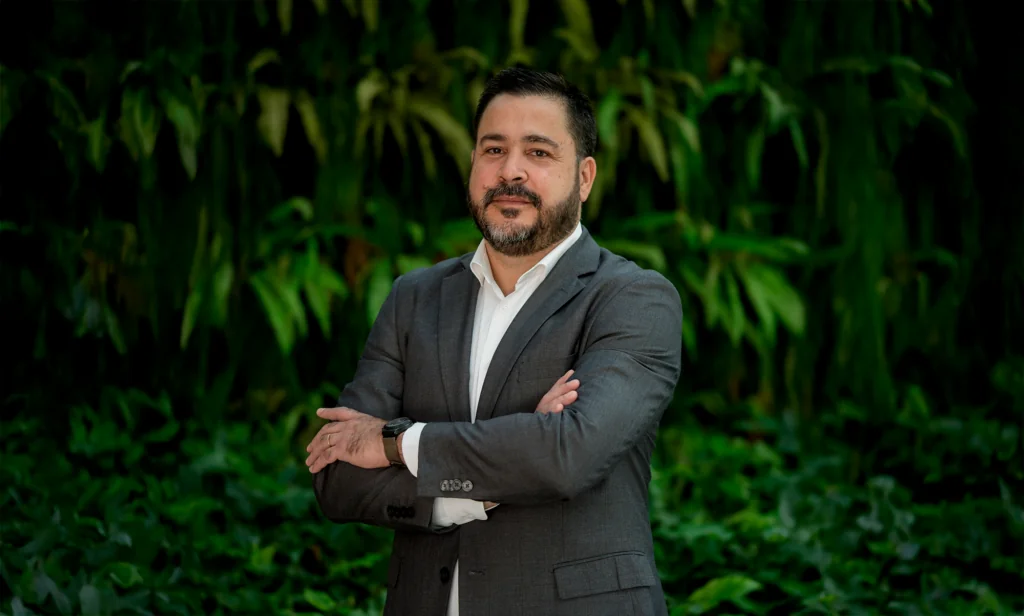
Foto: Personal Archive with expansion IA generated
By Maria Garcia*
In this 69th edition, the Um Grau e Meio newsletter speaks with Fernando Sampaio to unpack the key points regarding the sustainability (or lack thereof) of Brazilian agribusiness.
Fernando is an agronomist who graduated from ESALQ/USP (Luiz de Queiroz College of Agriculture, University of São Paulo) and is a member of the Strategic Group of the Brazil Coalition on Climate, Forests, and Agriculture.
In this interview, Sampaio revisits the history of Brazilian farming, identifies the gaps in making it sustainable over the medium and long term, and addresses priority actions to consolidate an economically prosperous model allied with climate balance.
How did Brazilian agribusiness become the powerhouse it is today? Has the sector adopted sustainable practices?
Until the 1960s, Brazil was actually a major food importer. The country imported almost everything: rice, wheat flour, meat, milk, among other products. With the founding of Embrapa [Brazilian Agricultural Research Corporation] in 1973, and through investment in research and technology development, the country developed tropical agricultural techniques.
The tropical environment was never particularly good for agriculture. Major food-producing countries like Ukraine, Australia, Canada, the United States, and Argentina have temperate climates. Farming in the tropical zone has always been more complicated because you have more pests, crop diseases, and a more unpredictable rainfall pattern.
It took a long time for us to start developing these technologies. Brazil, in fact, was the first tropical country to achieve this, whether through research from Embrapa or universities.
We have evolved in productivity and, primarily, in practices we call “low-carbon” or “regenerative” because they help conserve the soil, such as no-till farming (plantio direto). When people say Brazilian agro is sustainable, it means that the agricultural model allows Brazil and other tropical countries to increase food production while mitigating climate change through production systems that help reduce emissions and sequester carbon in the soil.
The practice of no-till farming, pasture recovery, ILPF (Crop-Livestock-Forest Integration), the use of bio-inputs and inoculants… There is a series of established practices that help agriculture become increasingly sustainable.
Why, then, are these practices not implemented on a large scale? What are the challenges to consolidating this model?
Many areas in Brazil are occupied by low-productivity pastures. A portion of small producers cannot implement regenerative technologies, either due to difficulties in accessing investment or a lack of technical assistance.
The first major challenge is democratizing access to these practices and technologies to accelerate this transition and have more people practicing sustainable agriculture.
The second major challenge is the dynamics of land occupation. Brazil is also a country with a recent history of territorial occupation. Consequently, many different policies encouraged people to migrate to the Midwest and the North, creating agricultural frontiers in the Amazon and the Cerrado, where new areas are deforested to be occupied by farming.
Our work at the Coalition, generally speaking, is to think about containing deforestation through public policies. We don’t need to deforest more to produce more. With that in mind, how do we generate value for the standing forest? What are the policies and financial instruments we need to give value to the forest left standing?
To what extent are programs and credit lines linked to the Plano Safra (Harvest Plan)—such as Renovagro and ABC+—integrated to contribute to agricultural production without illegal deforestation?
The Plano Safra is a subsidy that enables agriculture to finance itself—government and banks lower the production costs for rural producers. Every country in the world has agricultural subsidies; in fact, Brazil’s investment is below the OECD average. Public money can also guarantee a positive impact on this agriculture.
Regarding good practices against deforestation, there have been some advances. For example, the Central Bank now directs banks to control the allocation of their resources to ensure they are not directed toward deforestation activities. This is an improvement because producers who deforest without authorization can no longer receive loans.
How did Brazilian agribusiness engage with the international community at COP30 regarding sustainable agricultural systems, even with countries from temperate zones?
One of the major agendas for agro at COP30 in Belém was to draw attention to agriculture as part of the solution to the climate crisis.
Oil generates greenhouse gas emissions, but you can adopt an energy transition with other, less polluting or lower-emission energy sources. That is the big discussion at COP. Agriculture, however, is not something to be discarded or replaced, because everyone will still need to eat. Therefore, agricultural production cannot stop as oil production can.
The agricultural sector wanted to bring to COP the importance of looking at agriculture as part of this solution, through the adoption of sustainable farming that will reduce impacts. The discussion is mainly about technological innovation to improve agricultural efficiency and decouple it from deforestation.
Speaking of deforestation, what is missing for the Brazilian agricultural model to depend less on the conversion of native vegetation?
If we look at it coldly, the vast, degraded, and underutilized areas already cleared today in Brazil would be enough to supply all current and future demand for at least two decades. We no longer need to deforest to produce.
We can make better use of land that is already cleared, and everyone knows this. Now, why does deforestation continue to happen? We need to unpack the reasons.
A large part of this deforestation is illegal, and the State has a central role in control and monitoring. It occurs mainly on unallocated public lands, which are the primary targets of land grabbing (grilagem) because they appear to be “no man’s land.” There is, therefore, a necessary job of land tenure regularization.
As for deforestation occurring on private land, it exists because, currently, it is more profitable for the farmer to deforest and produce than to conserve. To change this, we need other mechanisms such as carbon markets and PES (Payment for Environmental Services).
In your view, what are the priority actions to ensure that sustainable and regenerative agriculture becomes predominant in Brazil?
The priority is to control illegality, which will slow down deforestation faster. By ending illegal deforestation and implementing the Forest Code, we get very close to a zero-deforestation scenario. The third action after that would be the creation of incentive mechanisms for producers to maintain the standing forest beyond what is required by law.
The Forest Code is now 15 years old. It faced legal challenges at the beginning, and states had difficulty making it work, with departments finding it hard to keep up with all the CAR (Rural Environmental Registry) analyses. The fact that it is decentralized across states significantly delayed the system’s implementation, but automation has been accelerating the process.
However, complying with the Forest Code has a cost for the producer. Although it generates a benefit for everyone, the rural producer foots the bill alone. For us to change the mindset so that everyone wants to comply, despite institutional difficulties, we need to think about how we can generate financial value for conservation.
*Analista de Comunicação do IPAM