
As part of the COP15 program of the CMS (Convention on the Conservation of Migratory Species of Wild Animals) in Campo Grande, an event brought together researchers to discuss the role of wetlands and Ramsar sites in protecting migratory species.
The activity took place on Friday 27th, from 9am to 10am, at the Casa do Homem Pantaneiro, organized by IPAM (Amazon Environmental Research Institute), ISA (Socio-Environmental Institute), INPA (National Institute for Amazon Research) and Imazon (Amazon Institute for Man and the Environment).
A preliminary analysis by IPAM scientists on the richness of migratory species and degradation factors in selected areas of the Amazon was presented.
According to the researchers, Ramsar sites in the Amazon have higher migratory species richness compared to indigenous lands and conservation units. However, the loss of water cover was identified as a potential risk for degradation.
Ramsar sites are perennially or seasonally flooded areas, such as mangroves, veredas and floodplains, but also freshwater or saltwater lagoons. They bear this name because they are the result of a convention signed in the city of Ramsar, Iran, to certify wetland conservation units.
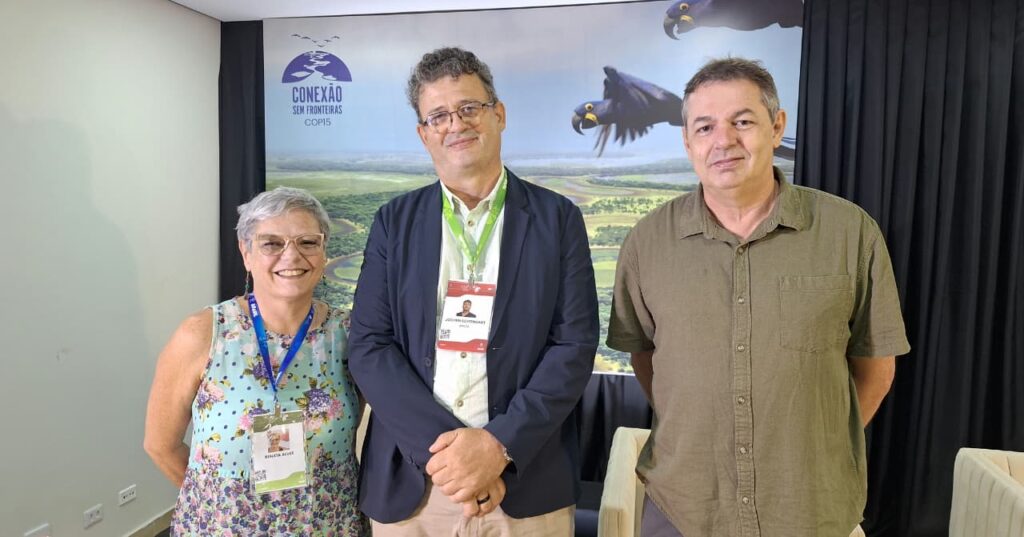
Participants in the event, Renata Alves (ISA researcher), Jochen Schongart (INPA researcher) and Carlos Durigan (IPAM researcher), as well as Carlos Souza Jr (Imazon researcher) remotely
“Our analyses corroborate the idea that actions aimed at conserving migratory species require strengthening the protection and consolidation of conservation units and indigenous lands, but also advancing in actions that go beyond these limits, on a biome scale – in the Amazon and beyond – guaranteeing connectivity between landscapes and countries. This is one of the central points under debate at COP15. In this context, Ramsar sites emerge as an additional strategic layer, especially for species associated with aquatic environments and wetlands,” says Carlos Durigan, a researcher at IPAM.
Jochen Schongart, a researcher from INPA who took part in the activity, said: “There are still large gaps in knowledge about migratory species of various taxa and their variation in occurrence over space and time in the Amazon. Therefore, the integration of indigenous and traditional populations into environmental monitoring programs and the occurrence of migratory species is fundamental to generating more information about the importance of wetlands in the Amazon.”
In order to increase the protection of species and prevent environmental degradation, the recommendations include, in addition to integrating traditional and academic knowledge for more effective actions, connecting existing protected areas and creating new Ramsar sites from the allocation of undesignated public forests. These forests occupy an area the size of Bahia in the Amazon and are awaiting state or federal definition of their land category.
To this end, the experts stress that medium and long-term financial support is needed to strengthen the participatory management of protected areas and the integrated conservation of large wetlands.
The negative effects of climate change on nature highlight the urgency of coordinated measures between the various sectors of society and international cooperation. According to reports released by CMS during COP15, 24% of the migratory species listed in the Convention are threatened globally and 49% are facing declines in their populations.
Migratory freshwater fish are among the animals most at risk: since 1970, their population has fallen by 81% worldwide – increasingly severe droughts explain this reality, along with water pollution, overfishing and the damming of rivers. With so many obstacles, it is difficult for species to navigate in search of food and to follow their reproduction cycles.
Renata Alves, a researcher from ISA, and Carlos Sousa Jr., a researcher from Imazon, also took part in the activity remotely.