
By Marcelo Freitas and Mayara Subtil
The forest can no longer be viewed as an obstacle to development, but rather as part of the solution for food production, climate stability, and the economy, and deforestation must be treated as “morally unacceptable.” This shift in perspective was at the heart of the discussions during IPAM Day at COP31, held this Monday (the 16th) at the Amazon Hub in the conference’s Blue Zone in Antalya, Turkey.
During three panel discussions, researchers, government representatives, and organizations from Brazil, Africa, Asia, and international bodies discussed the risks threatening the Amazon and ways to preserve the forest, strengthen food production, and increase funding for conservation.
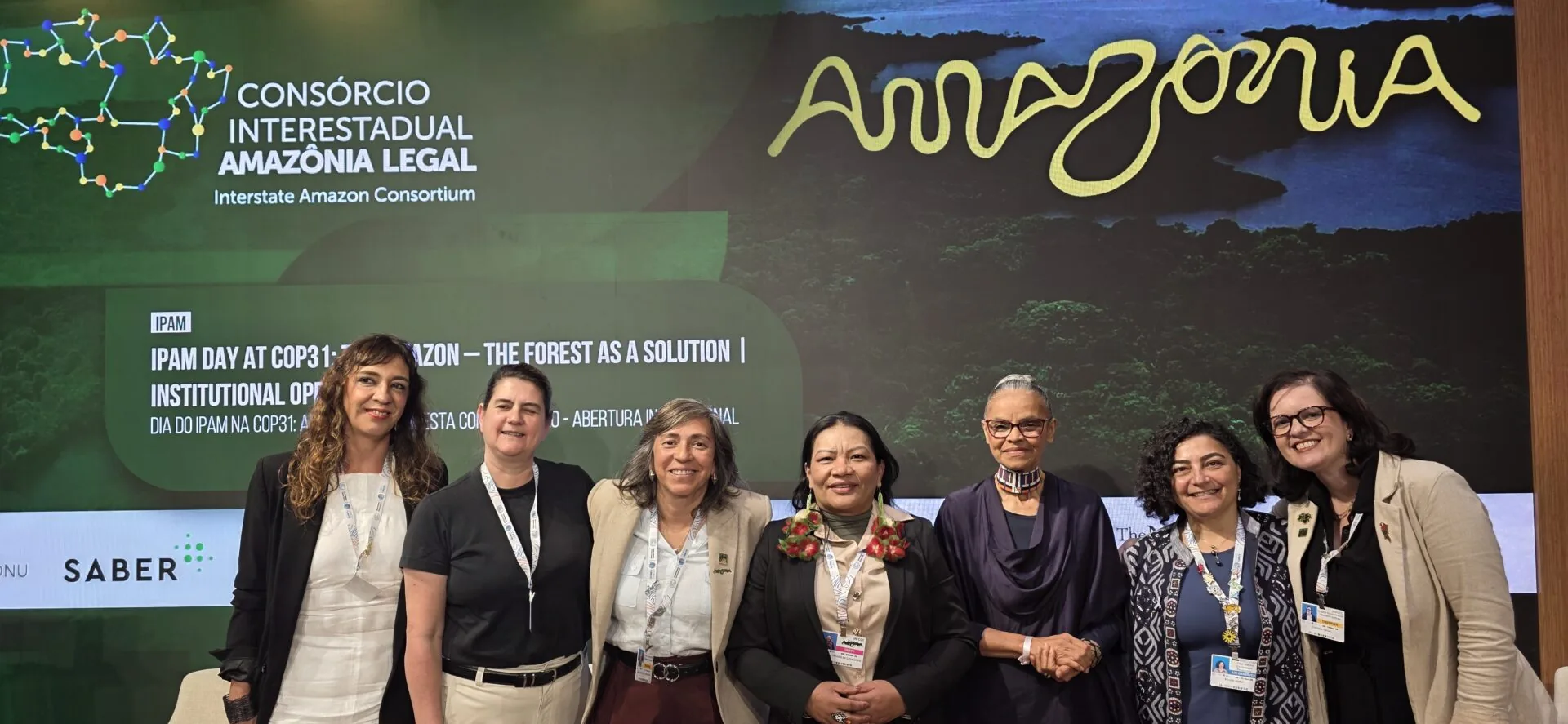
IPAM Day at COP31. Photo: Marcelo Freitas/IPAM.
The starting point is also a warning: the integrity of the Amazon sustains environmental services that extend beyond Brazil’s borders. Brazil produces about 10% of the world’s food, and the rainfall patterns associated with the forest contribute to agricultural production throughout the Southern Cone—a region that includes countries such as Argentina, Chile, Paraguay, and Uruguay, as well as southern Brazil—and accounts for significant portions of the global supply of soybeans, corn, meat, and coffee.
“There is no way to achieve the expected results of the Paris Agreement without the integrity of the Amazon. It’s as simple as that. We cannot ensure global environmental services and food security without the Amazon,” stated André Guimarães, executive director of IPAM (Amazon Environmental Research Institute).
The challenge, he said, is to ensure that the value of these services is recognized and reaches those who preserve the forest, and that society views the destruction of the forest through a moral lens—such as, for example, slave labor, torture, and homophobia. “Let’s make deforestation morally unacceptable,” he argued.
In the Amazon region, between 650,000 and 700,000 family farmers produce food and contribute to the conservation of these territories. Indigenous peoples, traditional communities, and Quilombola communities also need to be compensated for the environmental benefits they help preserve.
From Decision to Implementation
Marina Silva, a federal deputy and former Minister of the Environment and Climate Change, emphasized that Brazil has made progress in rebuilding its environmental policies and reducing deforestation, but that these results must be sustained by long-term commitments. In her view, roadmaps to end deforestation, transition away from fossil fuels, and expand financing are tools for transforming international decisions into concrete changes.
“It’s one thing to make a decision and put it on paper; it’s another to ensure its implementation,” Marina stated. She urged countries to move forward in developing their own roadmaps, with measures capable of guiding investments, diversifying economies, and increasing prosperity. “Roadmaps are not meant to limit possibilities. On the contrary, they serve to broaden our prospects for life and prosperity on Earth,” she added.
The scale of forest fires was also at the center of the discussions. In 2024, Brazil recorded 30 million hectares burned. The annual average ranges from 18 million to 19 million hectares, while the United States and Canada combined record between 3 million and 5 million. The Amazon alone burns, on average, more hectares per year than those two countries combined.
Ane Alencar, director of science at IPAM, emphasized that these figures must be understood without ignoring the different uses of fire in the country.
“This does not mean, however, that we should demonize fire. It is also an important tool for productive activities in the country. The challenge, therefore, is to regulate the use of fire. And how can we do that in the context of climate change?” she asked. She also pointed out the increase in burned areas in different regions of the Amazon and in neighboring countries, such as Bolivia.
But the effects of extreme events go beyond damage to ecosystems. Mirei Atallah, of UNEP (United Nations Environment Programme), warned of the risk that the Amazon could reach an ecological point of no return, with changes in the forest’s structure, the water cycle, and the occurrence of fires. At the same time, she emphasized that the connection between ecosystems and the social and economic integrity of these territories can contribute to a path toward recovery.
Researcher Emily Boyd, who is involved in the scientific debate of the IPCC (Intergovernmental Panel on Climate Change), in turn, drew attention to social tipping points, which can occur when communities lose the ability to recover from climate impacts.
“One example is situations where communities must repeatedly recover from extreme events but lack sufficient time or conditions to rebuild before a new impact occurs,” she explained.
Boyd also highlighted that these impacts affect support networks, household economies, and ways of life. “We need to observe how adaptive capacity is being eroded, including aspects such as social support networks, household economies, and the response capabilities of local populations,” she stated.
Patrícia Pinho, IPAM’s deputy director of science, emphasized that conservation must take into account those who live and work in these territories. “There is a dimension that is still rarely discussed and receives little attention: the lives of the people who sustain the forest. We’re not just talking about Indigenous populations, but also about traditional communities.”
Producing and Restoring with the People
In the Amazon, expanding restoration requires securing long-term funding and strengthening the entire chain—from seed and seedling production to technical assistance and marketing. “There can be no transformation without technical assistance,” emphasized Lucimar Souza, director of Territorial Development at IPAM. The researcher also highlighted the rise in costs caused by the drought.
“When I started working on restoration in the Amazon, we estimated that the seedling mortality rate would be 10%. In other words, we already knew we would lose that percentage, so we needed to produce 10% to 15% more to ensure replanting. Now, we’re facing replanting demands as high as 30% or 40%. This is an effect we still don’t talk about much, but it directly impacts restoration costs, which are already high,” she explained.

Panel “Family Farming in the Amazon and Around the World: Producing Food, Restoring Landscapes, and Addressing the Climate Crisis” at COP31. Photo: Marcelos Freitas/IPAM.
Pressure on water resources for irrigation adds another risk when there is no planning. In addition to the necessary resources and infrastructure, restoration must take into account the characteristics of each territory and the living conditions of families. Ana Castro Euler, from Embrapa, emphasized that there is no one-size-fits-all model: production systems must combine crops with faster returns, such as corn, cassava, and bananas, with species offering higher added value, such as açaí, cacao, and andiroba, according to the needs of each community.
Producer participation is also crucial for ensuring the sustainability of these initiatives. In Kenya, community seed banks preserve traditional varieties and local knowledge. In the Bungoma region, farmers helped draft an agroecology policy extending through 2034, incorporating their demands into the strategy.
“Now, they have a policy they can identify with and in which their demands are represented,” said Faith Ngige of PACJA (Pan-African Alliance for Climate Justice). Ngige also argued that farmers should have a voice in international negotiations on agriculture and climate, so that decisions take into account the reality of those who produce food.
In Thailand, the Doi Tung initiative demonstrates how improving living conditions can go hand in hand with environmental restoration. A region once marked by poverty, opium cultivation, and deforestation has come to combine forest restoration, higher-value-added agriculture, handicrafts, and tourism. Investment in the processing and value addition of local products has spurred five businesses that today generate approximately $15 million in annual revenue.
For Ramrada Ninnad, Head of Sustainability at the Mae Fah Luang Foundation, this outcome depended on placing the population’s needs at the center of the strategy. “First, we must secure the population’s livelihoods. That way, people will also have the means and incentives to care for the natural environment,” she said.
Funding with Integrity and Recognition
Recognizing the value of the forest also involves changing the way agricultural production is understood. André Guimarães, executive director of IPAM, pointed out that research currently being conducted by the Institute indicates that soybean productivity can be up to 20% higher in areas near forest fragments. Nature, therefore, should not be treated as an element external to the economy, but as part of productive systems.
“We pay for fertilizers, machinery, and labor. Why not pay for nature as well? After all, it also contributes to production and should be recognized as a productive factor in agricultural systems,” he said.
The expansion of resources must be accompanied by mechanisms that ensure benefits for the communities that conserve these territories. The debate brought together experiences in public financing, long-term credit, carbon markets, payments for environmental services, and international funds.
Marcus Santiago, from the BNDES (National Bank for Economic and Social Development), presented initiatives such as BNDES Florestas and Restaura Amazônia. The latter has raised R$450 million to support restoration projects in seven states. The Amazon Fund, relaunched in 2023, has also expanded its scope once again, with projects in Amazonian municipalities and support for hundreds of thousands of families.
The discussion on international financing also included carbon market mechanisms and climate cooperation. Ivano Assenza, of the FAO (Food and Agriculture Organization of the United Nations), emphasized that these instruments must be designed with integrity, socio-environmental safeguards, and benefit-sharing mechanisms. In his view, it is essential to ensure that resources reach communities and respect the rights of indigenous peoples, women, and youth.
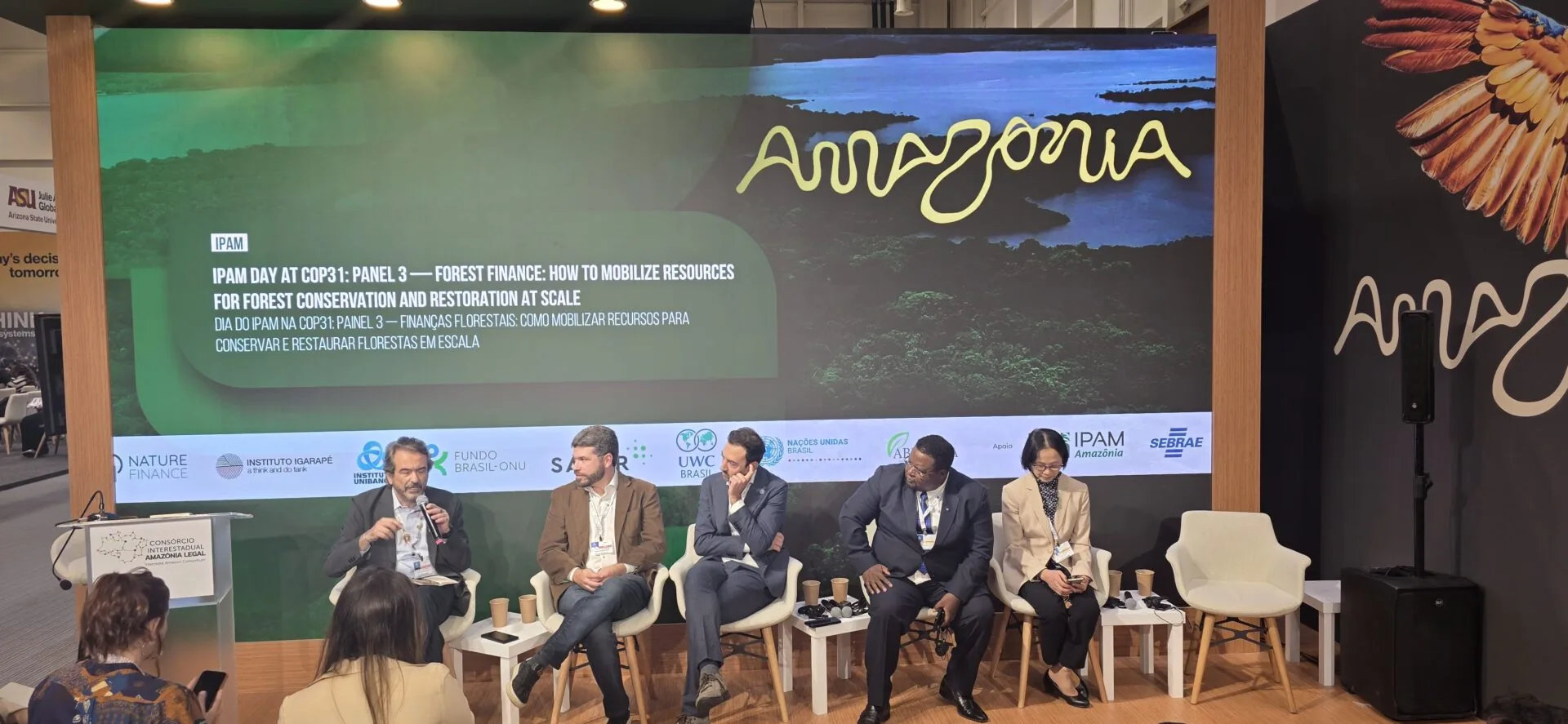
Panel on “Forest Finance: How to Mobilize Resources to Conserve and Restore Forests at Scale” at COP31. Photo: Marcelo Freitas/IPAM.
Lingshi Mo presented China’s experience in valuing forest assets, which combines direct compensation to farmers, carbon credits, and the use of forest rights as collateral for loans and long-term lines of credit. Rafael Dubeux, from the Ministry of Finance, emphasized the need to combine deforestation control policies with a new economic model for the Amazon. Dubeux also presented Brazilian initiatives for mobilizing capital, restoring degraded pastures, and financing the bioeconomy.
According to Augustine Njamnshi of the Biodiversity Development and Conservation Program in Africa, no conservation strategy will succeed if it ignores the people living in the forests. Njamnshi recounted how, during a field study, the mistrust of residents—who mistook researchers for loggers—was only overcome when the team established a relationship of respect and trust with the community.
“When conservation is done with the people and for the people, the chances of success are much greater,” he stated. The researcher argued that the ways of life and knowledge of African peoples should be recognized as part of biodiversity protection efforts and should receive financial compensation. “The efforts of African peoples to preserve forests and biodiversity—through their ways of life, their cultures, and their beliefs—must be recognized and financially rewarded. There is no need to require these populations to prove anything further,” he concluded.