
Combating wildfires is the primary way to reduce methane emissions in the Land-Use Change and Forestry sector, which are associated with fire and deforestation. Methane is a greenhouse gas about 28 times more potent than carbon dioxide.
This message is part of the new SEEG (Greenhouse Gas Emissions and Removals Estimation System) solutions booklet, released on Tuesday, the 18th, which includes recommendations for reducing methane in the main emitting sectors.
Click to view the handbook “Solutions for Reducing Methane Emissions in Brazil.”
In 2024, methane emissions from fires associated with deforestation reached 1.14 million metric tons, accounting for about 6% of the total 21 million metric tons of the gas emitted that year. Agriculture and livestock account for the largest share (75%) of this total, primarily due to cattle ranching.
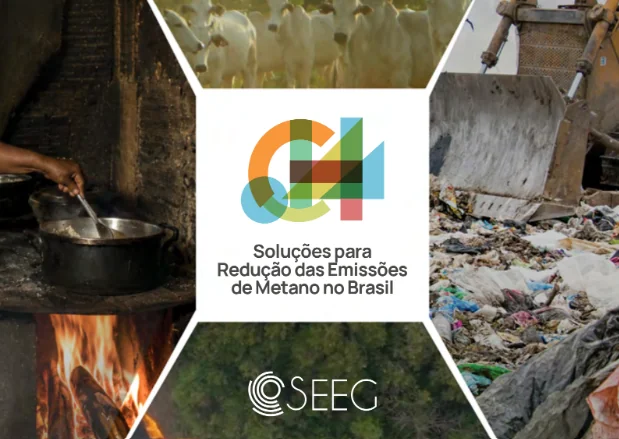
A handbook of solutions to reduce methane emissions in Brazil was launched on Tuesday, the 18th, by the SEEG initiative (Reproduction)
However, when it comes to methane emissions from fires affecting exclusively native vegetation, these are not yet included in the official inventories produced by government agencies to report Brazil’s greenhouse gas emissions. For this reason, SEEG presents this calculation as an additional figure: these emissions “not included in the inventory” amount to an additional 1.01 million metric tons of methane emitted in 2024.
Brazil is the world’s fourth-largest emitter of methane, trailing only China, the United States, and India, according to ClimateWatch. In 2021, at COP26 in Glasgow, the country joined the global commitment to reduce methane emissions by 30% by 2030.
“Methane emission reduction targets play a crucial role in combating the worsening effects of climate change. This is because methane is a gas with high global warming potential—28 times greater than that of CO2—but it also has a shorter half-life in the atmosphere. Therefore, mitigation measures focused on this gas have the potential to have a significant and rapid impact,” explains Bárbara Zimbres, a researcher at IPAM (Amazon Environmental Research Institute) and in the Land-Use Change and Forests sector at SEEG.
The document released by SEEG presents 37 solutions, five of which focus on the Land-Use Change and Forests sector. Reducing deforestation and preventing fires are on the list, with an emphasis on the role of states and municipalities in fire management and territorial governance—from prevention to firefighting.
Experts expect that the implementation of the National Policy on Integrated Fire Management will foster integration and coordination among the federal government, states, and municipalities, with a focus also on licensing the use of fire in agriculture and livestock.
“With the recent approval of the National Policy on Integrated Fire Management and in the wake of devastating wildfires across Brazil in 2024, we are at a very opportune moment to turn all these promises into action and prepare for the potential effects of the El Niño phenomenon that is now beginning. The Solutions booklet aims to summarize these areas of action in a practical way and help public entities prioritize the most effective strategies,” adds Zimbres.
Due to a strong El Niño already well established in the waters of the Pacific Ocean, attention is being focused on the risk of wildfires in the Amazon, given that the phenomenon tends to make the region drier while intensifying rainfall in the southern part of the country.