
By Lucas Ramos
“Don’t think that the work of preserving and conserving is only for those who live in the forest. Fighting for a stable world, country, and home isn’t just for traditional communities. Join us in this cause!”
It is with this sense of community that 18-year-old Maria Oliveira, known as Mariazinha, contributes to her community’s social organization. She was only 10 years old when she left the community where she was born, on the banks of the Juruá River in the Uacari Sustainable Development Reserve, to live on the other side of the river in São Raimundo, within the Médio Juruá Extractive Reserve in Amazonas.
It was there, while still a child, that her journey of social activism began. She found an existing youth collective, the JLPC (Youth Fighting for the Journey), and “from then on, I never stopped, right? It was one action after another,” she recalls.

📸 Maria “Mariazinha” Oliveira (JLPC Collection)
With more than two decades of existence, the collective seeks primarily to engage young people so they can participate in community life and discuss their issues as members of a traditional population. Today, the JLPC operates on four fronts that Mariazinha summarizes as fundamental: strengthening a sense of community, spirituality, culture, and a sustainable economy.
Tradition versus Technology
One of the central topics of debate among young people is the tension between traditional knowledge and the arrival of the internet in riverside communities. For Mariazinha, local youth have been drifting away from traditional practices—which she considers essential to her people’s identity—in favor of solutions found online. She attributes this shift to a desire to emulate urban life.
“We used to have knowledge that was superior to that of city dwellers, based on natural and traditional experiences. No one wants to drink medicinal tea anymore—which is an ancient tradition of our people—because on the internet there’s that medicine that’s the only thing that works,” she laments. “The youth in our communities are very much like the youth in the city. That’s why the collective has been working to show younger people that this knowledge is ours and that it’s important.”
Rebuilding a Sense of Community
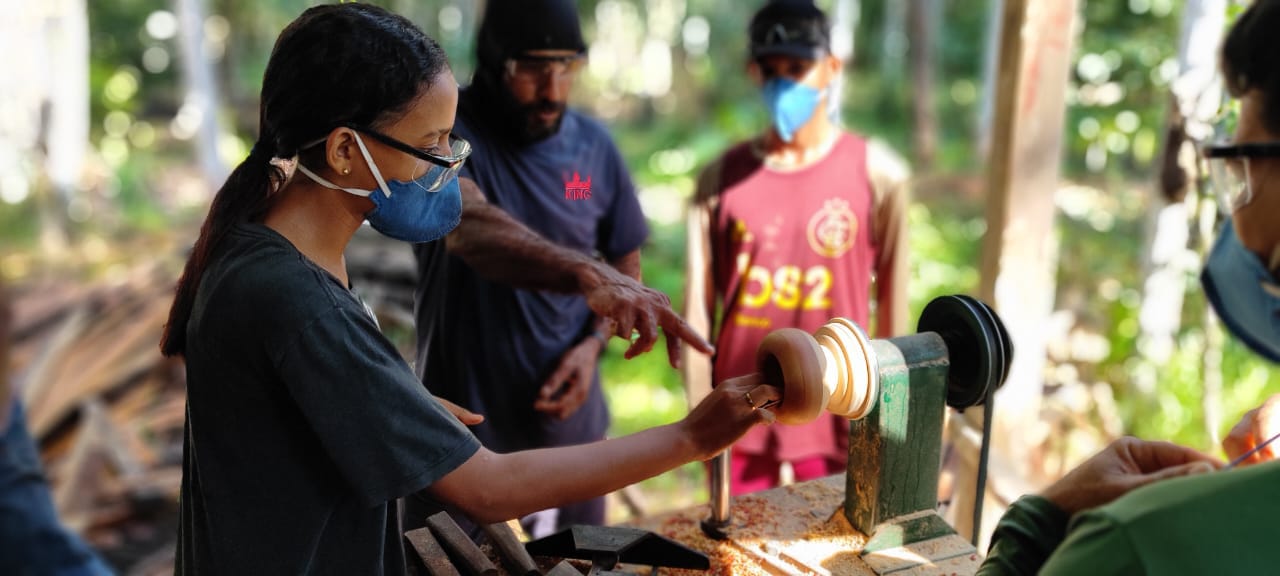
One of the pillars of JLPC’s work is the so-called “solidarity work parties,” a collective initiative in which the group of young people comes together to perform tasks on behalf of those who cannot do them alone or for the benefit of the community.
“We bring everyone together, and everyone works to help someone who can’t do that particular task. And then, every day, we organize a collective effort for a different person,” explains Maria. In this way, “everyone fulfills their essential tasks without feeling so burdened and also strengthens their sense of community.”
On a spiritual level, the group created the ODJ (Divine Office of Youth), which is brought to the homes of families who are unable to attend church. In the cultural sphere, the group has revived community celebrations on commemorative dates—a tradition, according to Maria, that was being lost.
Among the achievements she is most proud of, the young woman highlights a community mobilization that brought together the collective, the community, and the local association to ensure access to adult education. “This effort to bring education to those who didn’t have the opportunity to study is what has made me most proud throughout my entire journey with the collective,” she says.
📸 JLPC Collection
The Ecological Incubator and Forest Balance
About three years ago, faced with a declining turtle population—exacerbated by climate change and egg predation—the collective took on the responsibility of an “ecological incubator” project.
“It’s a kind of fenced-in nursery, filled with sand, where eggs collected from nesting beaches are safely incubated until the hatchlings can be returned to their natural habitat,” she explains. “From three years ago, when we started, until now, we can really see the difference—the increase that’s taken place,” says Maria.
This sense of ecological balance is shared by the entire community: “If the number of any species decreases, we feel it right away. It’s as if everything were in balance. If one declines, the others tend to follow. […] It’s as if they were the foundation for one another, the very balance of one another,” she explains.
Monitoring as Economic Education
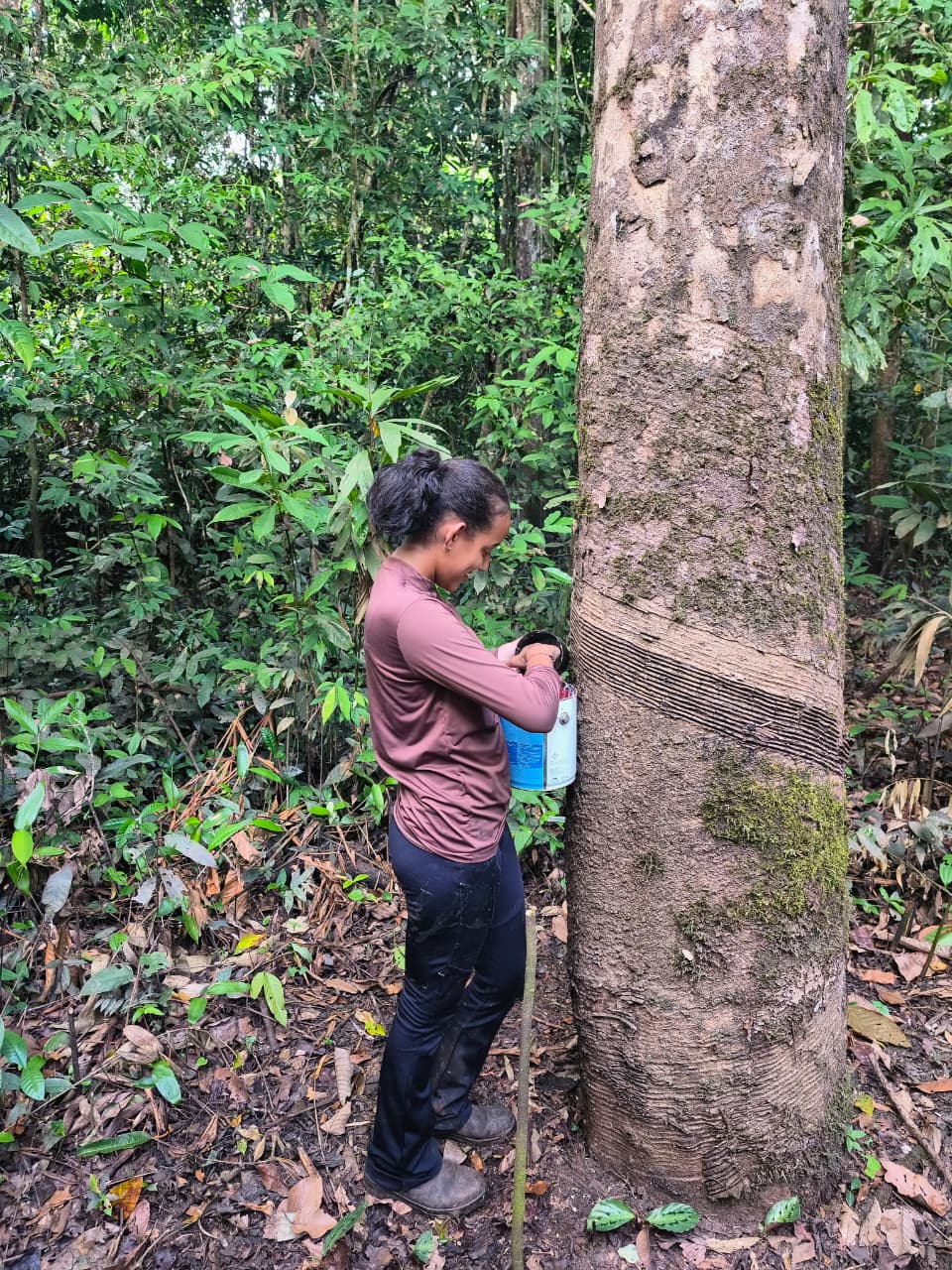
Mariazinha also draws a parallel between this social organization and concrete economic results achieved through monitoring the community’s core activities. The collective began monitoring latex tapping from rubber trees, preventing cuts that exceed the production capacity limit. According to the young leader, this practice drastically reduced tree mortality and also yielded financial benefits, since—in addition to ensuring the supply of latex for the coming years—the government rewards communities for demonstrably sustainable management.
“When the government sees the activity carried out properly, it expands public policy,” she explains. The rubber tree “is like a mother. It feeds many children, as long as it is tapped with respect for its limits. (…) Monitoring not only helps with the activity itself but also helps maintain this balance.”
📸 JLPC Collection
In another example, he cited the pirarucu management program that began in 2011. In the first year of management in the community, residents processed 60 pirarucus, but they didn’t even get paid for their work due to a lack of organization and knowledge. “They were kind of taken for a ride,” he summarizes. Over the years, as the youth-led community monitoring program matured, the activity became one of the main sources of local income, even helping to fund the installation of solar energy systems in several communities across the region.
A dream that transcends borders
Often chosen to represent the Middle Juruá region at meetings with other social organization movements, Maria cites a meeting in Bogotá, Colombia, and another in Óbidos, in Pará, where, according to reports she heard, local initiatives inspired projects after the activities carried out in the Middle Juruá were publicized.
“They told me there’s an initiative they launched there because they saw people from here in the Middle Juruá on YouTube. When we take action here and also post about it, it generates results for other municipalities,” she says.
Maria, as if downplaying her own greatness, speaks on behalf of an entire generation: “This dream isn’t mine, nor is it the collective’s—it belongs to all the young people of the Middle Juruá. We want to put together a caravan and travel around, sharing all this traditional knowledge.” The idea behind this “social caravan” is to bring to other communities—especially those lacking grassroots organization—the traditional knowledge, climate adaptations, and sustainable management practices developed in the Médio Juruá throughout its history.