
Bonn (Germany), June 17, 2026 – Forest fires are no longer just an environmental emergency; they have become a significant source of greenhouse gas emissions and a growing threat to biodiversity, communities, and climate stability. It was with this assessment in mind that governments, UN agencies, indigenous peoples, civil society, and scientists gathered this Tuesday (17), in Bonn, Germany, for an official event of SB64—the UN climate conference paving the way for COP31—dedicated to expanding integrated fire management as a climate solution.
Titled “From Action to Implementation: Scaling Fire Solutions to Reduce Wildfire Emissions,” the panel was based on a proposal by SOS Pantanal and organized in collaboration with IPAM (Amazon Environmental Research Institute), Uma Gota no Oceano, and the FAO’s Global Fire Management Hub. The meeting brought together representatives from governments, international organizations, indigenous peoples and local communities, civil society, and the scientific community.
The debate built on the main commitment made last year regarding this issue. During the Belém Climate Summit, on the eve of COP30, Brazil launched the Call to Action for Integrated Fire Management and Forest Fire Resilience — a document that calls on countries to replace the logic of emergency response with strategies for prevention, preparedness, and the ecological use of fire, combining science, technology, and the traditional knowledge of indigenous peoples and local communities. Launched with the initial support of 50 countries, the call has already been endorsed by 67 countries and four international organizations. In Bonn, the discussion focused precisely on the next step: how to move beyond commitment and achieve large-scale implementation before COP31, scheduled for November in Antalya, Türkiye.
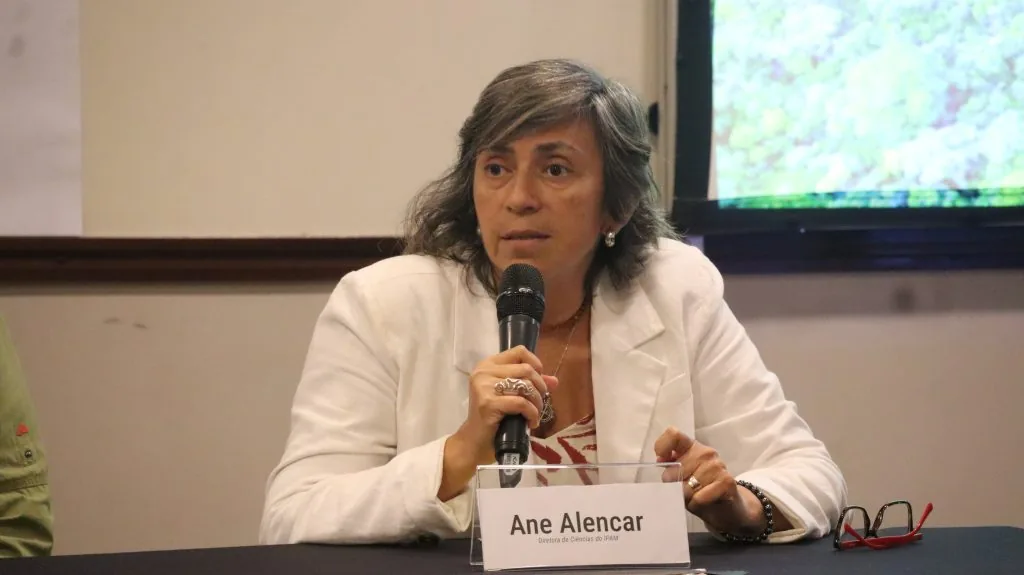
Ane Alencar, Director of Science at IPAM, participated in the event (IPAM Collection)
The first part of the event presented global fire trends and emissions data, alongside practical management experiences carried out in different regions—including initiatives led by civil society organizations and local communities. The second part focused on international cooperation, the role of the Global Fire Management Hub, and opportunities for financing and governance to scale up these solutions in the coming years.
Bringing this debate to an international forum like SB64 has strategic significance: it shows that integrated fire management, often developed on the ground in biomes under pressure and by those who live with fire on a daily basis, needs recognition, funding, and global coordination to move beyond being an exception and become a structured public policy.
“Sharing the experience we’ve had in the Pantanal in recent years is very valuable in this global context. We’ve shown how integrating local communities with government agencies and nongovernmental organizations can yield practical results and scale up into a public policy that listens to the community,” says Gustavo Figueirôa, Director of Communications at SOS Pantanal.
“It will not be possible to meet global climate goals without addressing the growing impact of wildfires. Fire is already a major source of emissions and threatens some of the planet’s key solutions and largest carbon sinks. The good news is that solutions already exist: expanding Integrated Fire Management can reduce emissions, strengthen the region’s resilience, and protect communities and ecosystems around the world,” notes Ane Alencar, Director of Science at IPAM.
“Communicating about wildfires is essential to highlight their socio-environmental impacts and their role in exacerbating the climate crisis—and, above all, to affirm that preventing them is not only possible but urgent and indispensable,” says Maria Paula Fernandes, Executive Director of the organization Uma Gota no Oceano.