On October 13 and 14, Brasilia will host the Pre-COP, a preparatory meeting for COP30 that brings together more than 600 representatives from around 65 countries to discuss the key themes of next month’s climate conference in Belém.
André Guimarães, executive director of IPAM (Amazon Environmental Research Institute), is taking part in the event as the COP30 presidency’s special envoy for civil society.
“It’s an opportune moment to discuss, iron out the kinks and define priorities so that we arrive in Belém with decisions in hand. For us envoys, it’s an opportunity to be able to bring some of what we’ve heard from society, the private sector, sub-national governments, etc., to contribute to this preparation for COP30,” he said.
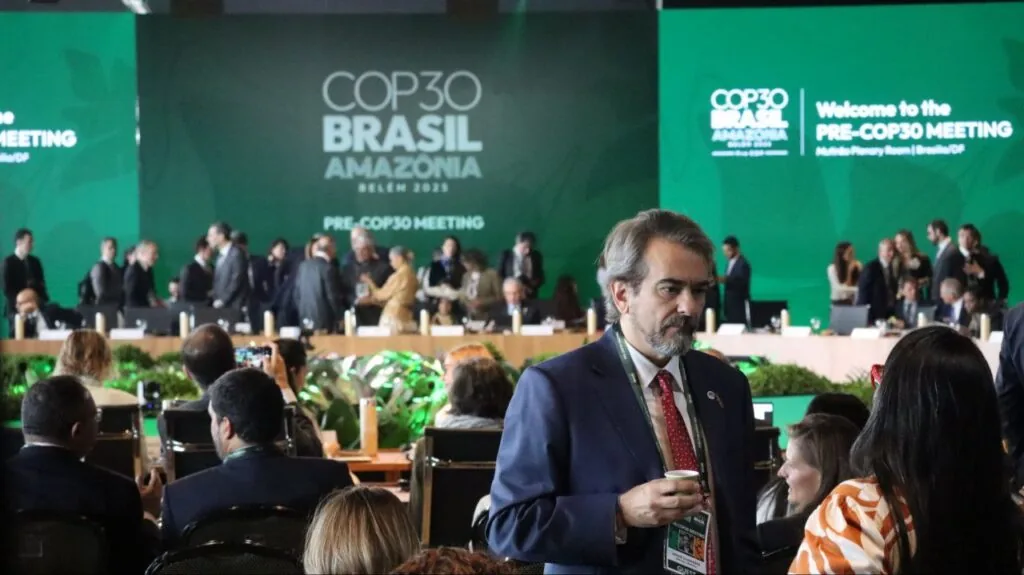
André Guimarães, executive director of IPAM, takes part in the discussions (Photo: Lucas Guaraldo/IPAM)
Vice-President Geraldo Alckmin opened the event by recalling the three main objectives of the Brazilian presidency at COP30: strengthening multilateralism, connecting the climate regime to people’s real lives and accelerating the implementation of the Paris Agreement.
“The collective effort of cooperation between peoples must be channeled here in the COP negotiations and concentrated on the NDCs [nationally determined contributions], with governments presenting NDCS aligned with the objectives of the Paris Agreement. Brazil’s NDC, which I had the honour of announcing last year at COP29 in Baku, brings the country’s new vision for 2030: a country that recognizes the climate crisis and draws up a low-carbon roadmap for its society, its economy and its ecosystems.” He concluded: “Brazil arrives at the COP as a country that believes that ethics, innovation and sustainability are not parallel paths, but the same path, the path of shared responsibility for the common future of humanity.”
Simon Steil, secretary of the UNFCCC (United Nations Framework Convention on Climate Change), stressed the need for unity to tackle climate change:
“COP30 comes at a critical time: a time to look forward. First, we need to send a clear message that the world is united against climate change and that all countries will stand together. Secondly, we need to speed up rehabilitation; we need to increase the implementation of adaptation measures that benefit billions. We have to show everyone what the benefits of sustainability are and how they can be achieved: more work, safety, health and economic growth. The difference is not how strong your positions are, but how effectively you can implement change,” he said.
Marina Silva, Minister for the Environment and Climate Change, addressed the Global Ethical Balance and the just transition.
“Ethics cannot be seen as a rhetorical device in the climate debate. The Global Ethical Balance recognizes the necessary transition and respects the particularities of each territory. Over the last few months, it has mobilized debates on all continents and 46 self-organized ethical stocktakings have been held in 15 countries. How can we ensure that the transition is just? How can we provide means of implementation in developing countries?” he asked.
“Climate change doesn’t give us the time that cultural change usually requires. The Global Ethical Review is, above all, an invitation to hope and reminds us that climate action will only be effective if it is also ethical. There will be no global leadership without moral leadership. Let the COP be the leader of the great effort and the results achieved so far. COP30 will be the foundation for new paths and new ways forward,” concluded Minister Marina Silva.
Fernando Haddad, Minister of Finance and leader of the Circle of Finance Ministers, reported on the work of more than 25 formal consultations that resulted in contributions to the governance of climate finance. In all, there were more than 1,200 suggestions from countries. He also mentioned the creation of the TFFF (Tropical Forests Forever Fund).
“The TFFF proposes a new financing model based on investment, not just donations,” he said. The minister also mentioned as strategic initiatives the carbon market aimed at the interoperability of regulated markets and the Super Taxonomy to guide investments.
Sônia Guajajara, Minister for Indigenous Peoples, highlighted the Peoples’ Circle as an innovation of the Brazilian presidency. “We are also part of the answer, which is why the Peoples’ Circle is an important innovation. So that we can also bring solutions that recognize territories as carbon sinks and, therefore, that policies to protect these territories are climate policies.”
The participation of indigenous peoples at COP30 will be the largest in the history of COPs, according to the Brazilian government. The minister said that more than 3,000 representatives of the world’s indigenous peoples are expected to attend the meeting in Belém, with at least 1,000 of them taking part in the official negotiations within the Blue Zone.
Cover photo: Pre-COP in Brasilia welcomes representatives from around 65 countries (Lucas Guaraldo/IPAM)