
In a webinar organized by Um Só Planeta to mark Amazon Day, André Guimarães, executive director of IPAM (Instituto de Pesquisa Ambiental da Amazônia), emphasized the role of the Amazon as part of the solution to the climate emergency and how the biome is fundamental to guaranteeing the planet’s food security. For him, the forest plays a strategic role and should be at the center of the debates at the UN Climate Conference, COP30, which will take place in November in Belém (PA).
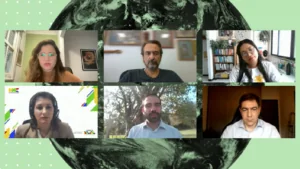
The webinar “Amazonia at the center of climate justice” was promoted by One Planet
“The Amazon is perhaps one of the most central pieces on the climate game board that we will be discussing at COP30. There is no possibility of humanity achieving the objectives of the Paris agreement, of ensuring the planet’s food security, without the Amazon,” he emphasized. “The forest stores the equivalent of 10 years of global carbon emissions. Without the Amazon, there is no climate balance. It irrigates agriculture in Brazil, neighboring countries and even Central America. If we put all these countries that depend on this natural watering hole that is the Amazon for food production together, we’re talking about a biome that helps produce food for 2 billion people.”
Civil Society Special Envoy to COP30 André Guimarães said that, considering other countries that have forests, the contribution to guaranteeing food on the table of the world’s population is even greater.
“The Amazon is the jewel in the crown of tropical forests, yes, but it represents approximately 50%. There are important forests in Africa, Indonesia and Asian countries. If you think about this tropical belt of the planet, we’re talking about half of the planet’s food production, which, in turn, just like in Brazil, also depends on natural rainfall cycles that are determined by the forests,” he said.
Deforestation
André Guimarães argued that the great legacy of COP30 should be an “end to deforestation forever” and long-term planning. “The challenge from now to 2030 and beyond is not just to reduce deforestation, but to develop the toolbox to keep deforestation down. We’re talking about incentives for landowners not to deforest, channeling more resources to indigenous communities and traditional populations that preserve the forest, payment for environmental services, investments to intensify agriculture. If we don’t do our homework and change the economic model, we’re going to see deforestation grow again,” he warned.
The director also spoke about the profile of Brazilian emissions compared to other countries: half come from deforestation, 25% from agriculture and 25% from activities such as transportation, construction, energy, etc. “Within this half of Brazilian emissions, caused by deforestation, more than 95% is the result of illegal activities. In Brazil’s case, fighting crime, i.e. arresting criminals to reduce deforestation, is fulfilling our international commitments to reduce emissions,” he said.
Climate finance
The main stumbling block in recent editions of the COPs, climate finance should move in an alternative direction, according to Guimarães. For him, the climate change scenario imposes the need to change the expansionist model for mechanisms that value preservation and he cited the TFFF (Tropical Forests Forever Fund). “A new paradigm is beginning to be built in which the forest and natural systems start to have value for human systems. The TFF is evidence of this, that standing forests are paid and that the traditional populations who look after these forests are paid for the service they provide for the whole of humanity. It’s a financial tool that promotes justice,” he argued.
The webinar “The Amazon at the heart of climate justice” was attended by Natalia Mapuá, Coordinator of the Youth Alliance for Energy Governance; Nabil Kadri, Superintendent of the Environment Area at the BNDES; Henrique Leite de Vasconcellos, Executive Manager of the ESG area at Banco do Brasil; Mariana Espécie, Special Advisor to the Minister of Mines and Energy; and was mediated by Vanessa Oliveira, assistant editor of Um Só Planeta.