
By Bibiana Alcântara Garrido*
IPAM (Amazon Environmental Research Institute) and China Jiliang University signed a scientific cooperation agreement on Wednesday and launched the “Sino-Brazilian Sustainable Development Center” for the development of joint actions.
The ceremony took place in Brasilia, as part of the “Brazil-China Researchers Symposium on Forests and Nature – COP30 and Beyond”, organized by UNEP (United Nations Environment Programme) in partnership with IPAM, Nature Partner Initiative, China Jiliang University and Renmin University of China.
Together, IPAM and Jiliang will research the impacts of climate change and the opportunities in technology and food systems in this scenario, addressing nature-based solutions in rural and urban contexts.
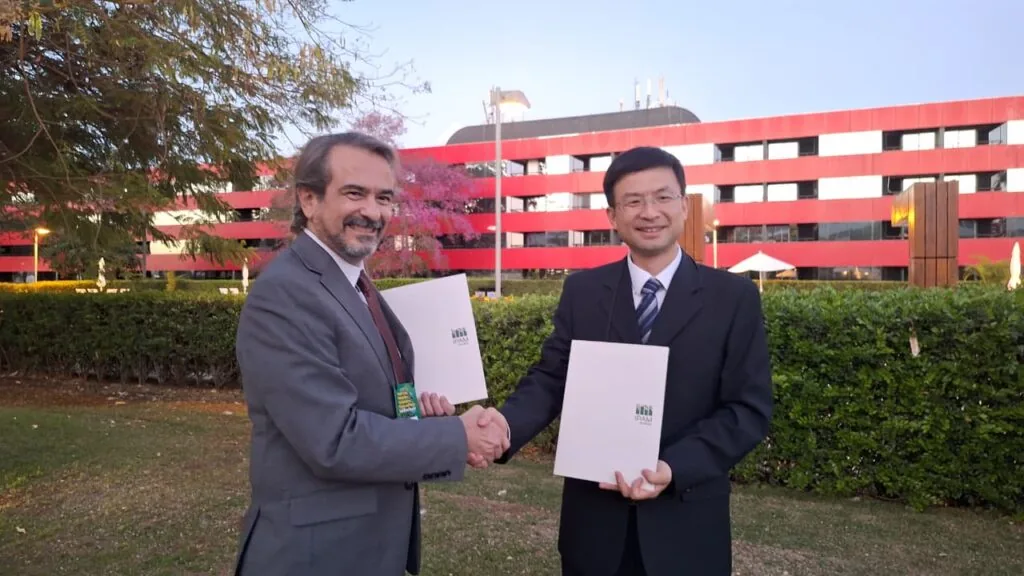
André Guimarães, executive director of IPAM, and Yu Wei, director and researcher at China Jiliang University, sign the agreement for scientific cooperation
“Today we signed the memorandum of understanding that formally unites IPAM and Jiliang University for the development of research. We are thus planting a seed for a better and sustainable world, looking after future generations and the future of the planet,” celebrated André Guimarães, IPAM’s executive director and COP30 special envoy for civil society.
Guimarães, who is also acting as COP30’s special envoy for civil society, added: “One of the most important words being used by the COP30 Presidency is ‘mutirão’, a concept of indigenous origin that translates as working together for a common good.”
The agreement has an initial duration of two years and provides for the preparation of joint studies and the promotion of exchanges between students and researchers, as well as the sharing of data and the holding of events. The production of academic materials and information content in various formats is also included in the memorandum of understanding.
“It is a great honour for us to formalize this partnership with IPAM. On both sides, we have a lot of potential for cooperation on climate change, sustainable agriculture and nature conservation. We understand that China and Brazil have similar sustainability challenges, so our efforts will be aimed at overcoming these difficulties,” said Yu Wei, director and researcher at China Jiliang University.
“In addition to the memorandum of understanding, we are also launching the Sino-Brazilian Center for Sustainable Development, through which we will share experiences and knowledge from China and learn from Brazil to further strengthen our partnership,” added Professor Wei.
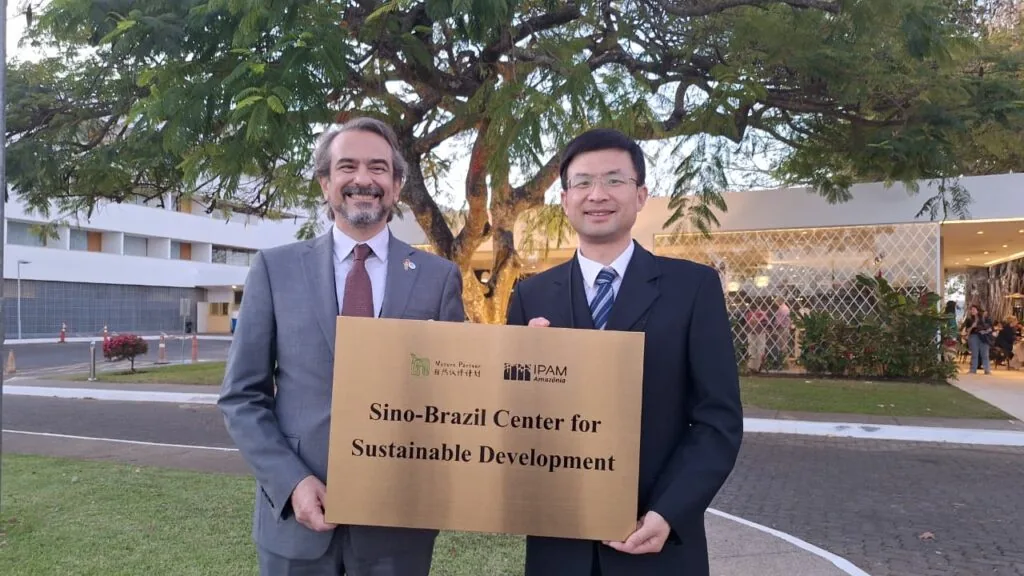
Launching of the Sino-Brazilian Center for Sustainable Development
The Sino-Brazilian Center for Sustainable Development by IPAM and Jiliang University, launched on the same date as the signing of the research agreement between the institutions, adds bricks to the construction of the China-Brazil Community with a Shared Future for a Fairer World and a Sustainable Planet, defended in an official statement by the two countries after Chinese President Xi Jinping’s visit to Brazil in 2024.
“With the Sino-Brazilian Center for Sustainable Development, bilateral technical and scientific cooperation will be facilitated, as it will be a platform for exchange and a space for sharing information, data and good practices between the two countries. It is a meeting place, promoting partnerships in research projects between universities, research institutions and think tanks in Brazil and China,” concludes Olivia Zerbini, a research analyst at IPAM and one of the initiative’s coordinators.
The strengthening of ties between institutions in Brazil and China comes in the wake of the Brazilian civil society mission to the Asian country in June 2025, in which six Brazilian environmental organizations met with Chinese governmental, non-governmental, university and association representatives to discuss conservation and green trade.
*IPAM journalist, bibiana.garrido@ipam.org.br