
André Guimarães, executive director of IPAM (Amazon Environmental Research Institute), took part on Thursday (21) in Bogotá, Colombia, in a meeting with representatives of 20 Colombian civil society organizations to present the COP30 Action Plan. The United Nations Climate Conference will take place in November in Belém (PA).
The document has been drawn up, including with the participation of Brazilian civil society, to serve as a legacy of the COP and present solutions, based on the Global Balance Sheet (GST), aimed at implementing existing measures that accelerate the reduction of emissions of polluting gases into the atmosphere.
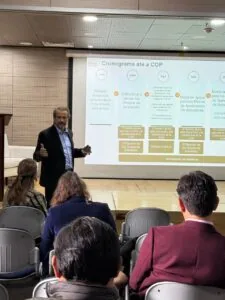
The meeting in Bogotá brought together civil society institutions that have shown an interest in taking part in discussions on the climate agenda (Paula Alvarez Gaitan/CI Colombia)
“It was an extremely productive meeting. What impressed me most was the engagement and willingness of Colombian civil society to participate effectively in the climate agenda,” said André Guimarães, also COP30 Special Envoy for Civil Society. “Both in the run up to Belém and after Belém, we will have to remain attuned and dedicated to continuing to implement the agenda, despite all the geopolitical difficulties and uncertainties, but the concrete fact is that the climate continues to change and we have to act.”
Financial mechanisms
During the Summit of Amazonian Countries in Bogotá, alternatives for climate finance were also presented and will be debated at COP30, such as the TFFF, the Tropical Forest Forever Fund, which will grant incentives to countries that adopt actions to prevent deforestation and forest degradation.
“One aspect I found very interesting was the massive presence of indigenous groups supporting the TFFF. Of course, they have a direct interest, which is the 20% that will be allocated to indigenous populations, but the support of these groups is extremely important in order to be able to capitalize and put this ambitious financial mechanism into operation,” said André Guimarães.
Climate finance has been the main challenge of the Climate Conferences and an agreement to reach 1.3 trillion dollars a year is still a long way off. That’s why we need to find other ways.
“TFFF, REDD+, direct financing, compensations, investments, are all mechanisms for forest conservation that allow us to change the paradigm of a lying forest being worth more than a standing forest,” he said.
Ethical Balance
In Bogotá, the Brazilian government unveiled the Global Ethical Balance (GES), which will take an ethical approach to the actions that still need to be implemented in favor of climate change, respecting the knowledge of science and traditional peoples and communities, and in line with the Paris Agreement’s goal of reducing the planet’s average temperature by 1.5ºC compared to pre-industrial levels.