
Karina Custódio*
Young indigenous people, quilombolas and extractivists from the Legal Amazon presented 18 climate adaptation plans to representatives of public authorities and community funds between June 14 and 17 in Brasilia. The presentations were part of the face-to-face meeting of the Youth for Climate project, an initiative of IPAM (Amazon Environmental Research Institute), with support from EDF (Environmental Defense Fund) and a partnership with Cultural Survival.
The presentations to representatives of federal government ministries and climate funds seek support for the implementation of adaptation plans. The government representatives recognized the relevance of the proposals and pledged to forward them to their departments.
The strategies were developed over five months together with the communities to which the leaders belong. “The project and the resulting adaptation plans are a way of combating climate change from the ground up. Public policies and national actions to tackle the climate emergency are very important, but the effects of climate change are felt in the territories, at a local level, so the response also has to come from them,” says Martha Fellows, a researcher at IPAM.
The plan of the community of Fernando José Neves, from the quilombola territory of Campo Redondo, in Maranhão, focused on reforestation with native plants.
“Taking part in Youth for Climate was a privilege. Before the training I spoke to my community and they liked the idea. This initiative gives us an experience of the collective, of sitting down with the community and seeing what our problems are. Because we often face problems, but we don’t sit down and talk about how to solve them. This initiative brought that opportunity,” he explains.
To draw up the plans, the young people received research and training grants on the climate emergency and public adaptation policies, provided through support from the EDF.
“Engaging young people is vital to curb climate change, and that was one of the project’s objectives. These young people will inherit many problems left by previous generations, so whatever we can do to support them, we will do,” commented Beatriz Saldanha, EDF representative.
Impacts and adaptation targets
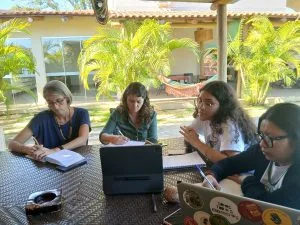
Young people presented strategies to representatives of the Federal Government in search of support.
The plans mapped the main impacts caused by climate change in the communities and established goals to increase the resilience of the territories.
Among the impacts listed are drought, rising temperatures and fires, and unstable rainfall. These factors reduce agricultural, fishing and handicraft production, which are the main sources of income for indigenous, quilombola and traditional community populations. There are also effects resulting from economic exploitation in the vicinity of the territories and the lack of security in relation to full ownership.
The resilience goals were diverse, but most focused on strengthening the community to prevent food insecurity, with solutions based on people and nature.
“Our adaptation plan consists mainly of building a community vegetable garden so that we can replant the medicinal plant species devastated by the exploitation of tourism in the territory,” says Rilary Borari, a young indigenous woman from the Alter-do-Chão indigenous territory in Pará.