
Bioindustry in the Amazon
Bioindustry in the Amazon: Contributions to Sustainable Development in the Legal Amazon.
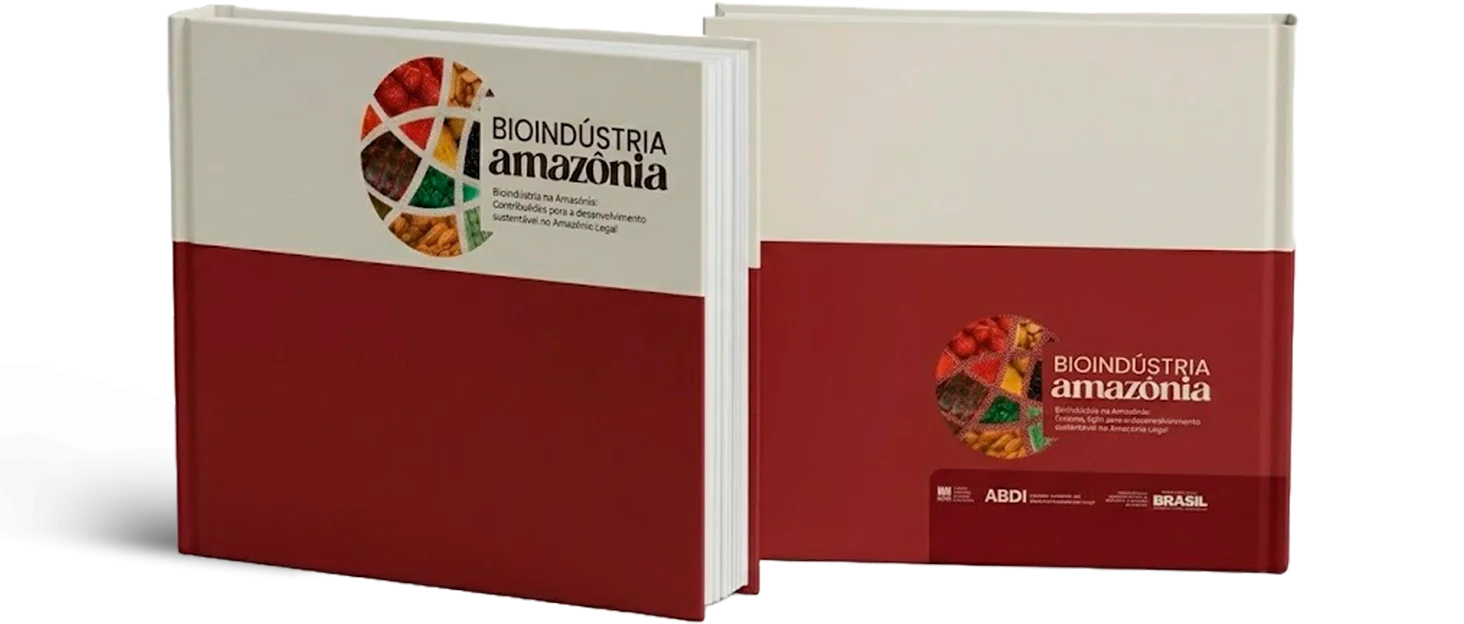

The book is the result of a research and systematization effort carried out in partnership between ABDI (Brazilian Agency for Industrial Development) and IPAM (Amazon Environmental Research Institute).

Project Overview
The book presents an unprecedented analysis of the bioindustry ecosystem in the Legal Amazon, demonstrating that the sector is not merely a promise for the future, but a reality that is already generating value while preserving the standing forest. The book seeks to raise awareness of these ventures and proposes pathways for the formulation of public policies that will structure these production chains.
Key Findings:
'Amazonizing' Bioindustrialization
The book presents the perspective that industrializing the Amazon does not mean replicating external models, but rather adapting the concept to the region’s ecological and sociocultural reality.
Biodiversity as Living Infrastructure
The forest and socio-biodiversity are not obstacles, but rather the material and strategic foundation that shapes and guides local industrial organization.
Value Aggregation Gradient
The study shows that the bioindustry in the region operates across a mosaic of trajectories. A large portion operates in short supply chains and early stages of processing, while a smaller portion already has access to broad markets with more mature enterprises and more complex products.
A Snapshot of the Bioindustry in Data
11,688
A total of 11,688 formal businesses related to the bioindustry were identified in the Legal Amazon.
220,000
The sector drives the economy by generating approximately 220,000 direct jobs and impacting 879,000 people.
76.4%
The business sector consists mainly of small businesses: 76.4% are microenterprises and 9.4% are small businesses.
4,496
Pará leads in territorial concentration with 4,496 businesses, followed by Amazonas with 1,810 and Mato Grosso with 1,636.
15.3%
The most widespread production sector is food and beverages, particularly categories such as canned goods (15.3%) and juices (8.3%).
The analyses were based on available official data and highlight the challenges in classifying enterprises using taxonomies that are not necessarily appropriate for the bioindustry (e.g., CNAEs).
For more details on the data, visit the
Amazon Bioindustry Power BI:
Production Chains and Structural Challenges
Major Chains
The book highlights the foundational role of the açaí, Brazil nut, cassava, and cassava derivatives supply chains, as well as the creative economy (fashion and handicrafts).
Mapped Bottlenecks
The development of the bioindustry is limited by challenges such as bureaucratic hurdles in obtaining health approvals, inadequate logistics infrastructure, low technological capacity, the formalization of businesses, and restricted access to financing and working capital.
Proposals and Paths
Bioindustrialization as a State Strategy
The book concludes that the bioindustry must move beyond being a collection of isolated initiatives to become an integrated strategic agenda involving the federal government, states, municipalities, and private initiatives.
Enabling Conditions
To overcome structural limitations, the project proposes strengthening cooperatives and local arrangements, creating specific lines of credit, bringing processing centers closer to production areas, and fostering innovation rooted in the local community.
Read the full article and learn about the paths to sustainable development in the region.